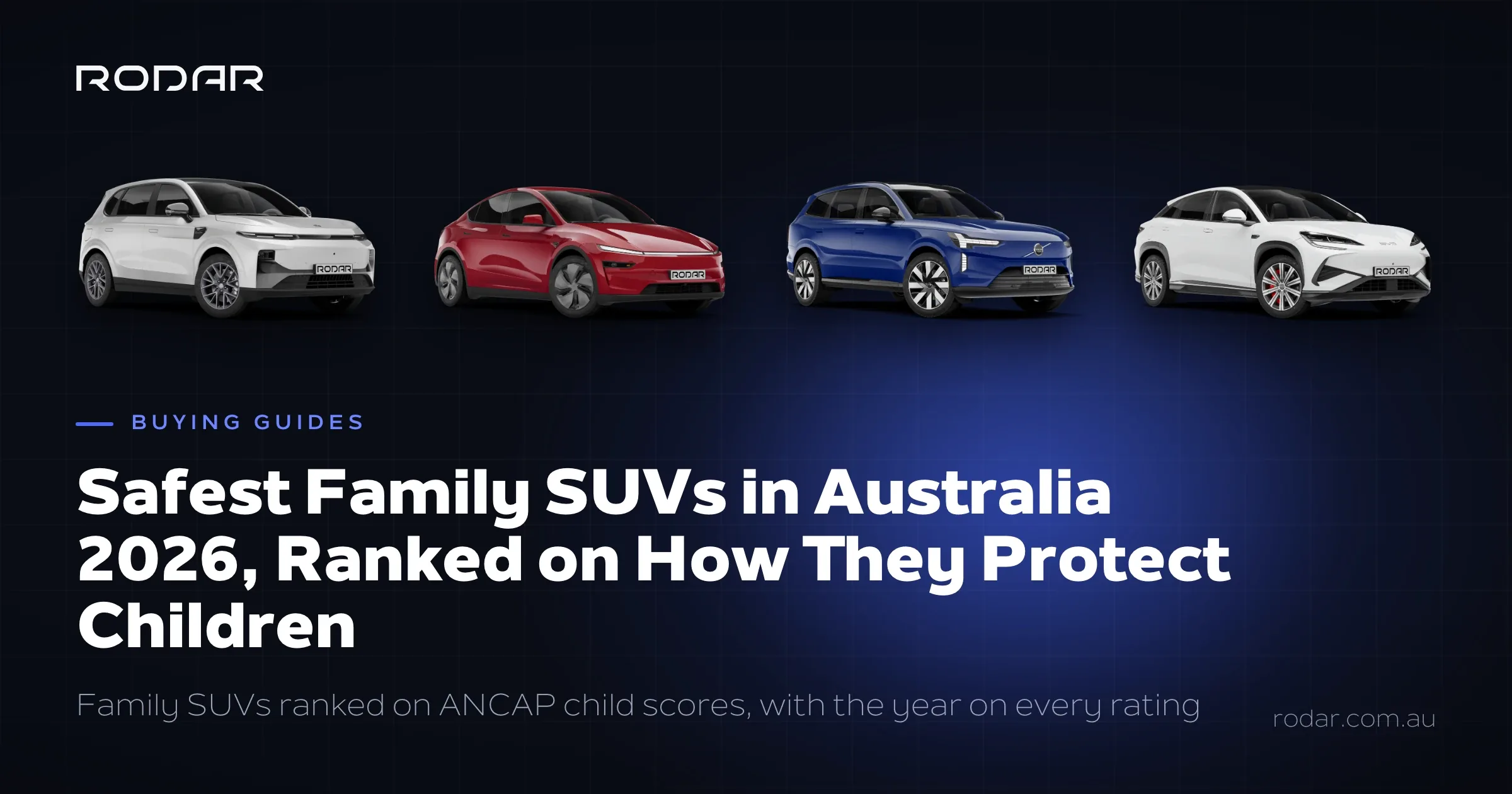
Every family SUV on your shortlist says five-star ANCAP. That is reassuring, and it is also why the badge cannot help you choose. The question you are really asking is harder: which of these will best protect your kids, and does that rating belong to the car you will actually get?
You do not need to read a crash report to answer it. For every car ranked here, ANCAP scores how well it protects children out of 49 points, and the year printed beside the stars tells you which test it passed. Below are the family SUVs with the highest child scores, ranked in two tiers by the year they were rated, with the year and expiry of every rating. For our picks, we also show what each score is made of and the builds it covers. When you have a shortlist, Rodar can put the exact car to our network of over 1,000 trusted automotive dealers and manufacturers and bring the offers back to you. If you are still deciding what kind of car you need, start with our guide to the best cars for new families.
Five stars is where you start, not where you finish
Every SUV ranked here has five stars. The difference between them sits in the child occupant score, which ANCAP builds from four parts:
- Dynamic (Front), 16 points. How well the car protects child dummies, seated in child restraints, in a frontal offset crash.
- Dynamic (Side), 8 points. The same, in a side impact.
- Child Restraint Installation, 12 points. Whether a range of typical child restraints sold in Australia and New Zealand can be fitted correctly in each rear seat.
- On-Board Features, 13 points. The child-related equipment fitted to the car. Under the 2023 to 2025 criteria, child presence detection is worth up to 4 of these points.
Of the eleven SUVs we rank below, nine score the full 24 points in both crash tests. So most of the gap between an 89% car and a 95% car is about whether child seats fit correctly and which child features are fitted, not about how the car performed in the crash.
Which part matters depends on how old your kids are
ANCAP's crash dummies are a 6 year old and a 10 year old, so the two crash scores speak most directly to school-age children. ANCAP's chief technical officer, Mark Terrell, put it plainly to Baby Drive: for children at that age, "It is really how good the car is, rather than how good the child seat is."
For a baby, the installation score is the closer guide, because it records whether a capsule could be fitted correctly in each rear seat. If you have one of each, read both.
A few family SUVs dropped points in the crash tests themselves. Out of 16 in the frontal test, the Mitsubishi Outlander scored 12.81, the Isuzu MU-X 13.99, the Kia Sorento 14.89 and the Nissan X-Trail 15.28. All four still carry five stars.
How the ranking works
ANCAP tightens its test criteria every three years, and its own advice is to check the datestamp so you are comparing "vehicles rated to similar test criteria". So we rank in two tiers. Tier one is cars rated under the 2023 to 2025 criteria. Tier two is cars rated under the 2020 to 2022 criteria whose ratings run to December 2027 or later. Within each tier, cars are ordered by child points out of 49, which separates cars that round to the same percentage.
Every score is ANCAP's, checked against its rating pages on 15 October 2026. The picks and the order are ours. Prices are the regular retail price of the lowest grade, as shown on Rodar's model pages, including estimated on-road costs. They are indicative only and current as at October 2026.
Tier one: rated under ANCAP's 2023 to 2025 criteria
Leapmotor B10: 47.00 of 49
The Leapmotor B10 has the highest child score of any SUV ranked here. ANCAP says its 95% is "equal to the highest achieved under ANCAP's 2023-2025 testing criteria". It scored full marks in both crash tests and full marks for seat fitting: every restraint ANCAP selected fitted correctly in every rear seat. Child presence detection is a direct system, standard on all seats. From $41,930.

The rating. Datestamp 2025, expires December 2031, covers cars built from September 2025. ANCAP's record describes the battery electric B10. The B10 is also listed in REEV (range-extender) grades, so if you are quoted one, confirm the rating covers it before you rely on it.
Tesla Model Y (five seats): 46.62 of 49
The five-seat Tesla Model Y scored full marks in both crash tests. It dropped a little on seat fitting: ANCAP could not correctly install the capsule or one of the booster seats in the centre rear position. Child presence detection is direct and covers every seat. From $63,570.

The rating. Datestamp 2025, expires December 2031, covers five-seat cars built from February 2025 and on sale from May 2025. It does not cover the six-seat Model Y L, which is rated separately at 84%. With Tesla, the saving comes through a novated lease, explained in our guide to novated leasing an electric car.
Volvo EX90: 46.54 of 49
The Volvo EX90 has the highest child score of any seven-seater here whose third row has top tether anchorages. ANCAP lists top tethers in every rear seat, curtain airbags reaching the third row, and a belt pretensioner in the second-row centre seat. Child presence detection is direct. In the third row, ANCAP notes care is needed to install a capsule. From $113,100.

The rating. Datestamp 2025, expires December 2031, covers cars built from December 2024. For more three-row options, see our guide to seven-seat SUVs.
BYD Sealion 7: 45.81 of 49
The BYD Sealion 7 scored full marks in both crash tests. One of the booster seats could not be correctly installed in the centre rear seat. Its child presence detection is a direct system, fitted to all seats. From $59,540.

The rating. Datestamp 2025, expires December 2031, covers cars built from January 2025. With BYD, the saving comes through a novated lease. If you have not used one before, our guide to whether novated leasing is worth it walks you through it.
Mazda CX-5 (new generation): 45.00 of 49
The new Mazda CX-5 scored full marks in both crash tests and full marks for seat fitting. The points it dropped were on-board features: ANCAP lists child presence detection as not available.
&paintId=pspc0041sspc0146&angle=1&zoomType=fullscreen&zoomLevel=30&width=800&fileType=webp&bodyType=suv&bodySize=4)
The rating. Datestamp 2025, expires December 2031, covers cars built from April 2026 and on sale from June 2026. The previous CX-5's rating expired in December 2023, so make sure the car you are quoted is the new one.
Subaru Forester: 44.72 of 49
The Subaru Forester is one of only two of our eleven picks with a belt pretensioner in the second-row centre seat, which matters if a child in a booster rides in the middle. It scored 15.78 of 16 in the frontal test and 7.88 of 8 in the side test. Child presence detection is standard, and ANCAP describes it as indirect. From $47,700.
&paintId=pspc0100sspc0004&angle=1&zoomType=fullscreen&zoomLevel=30&width=800&fileType=webp&bodyType=suv&bodySize=4)
The rating. Datestamp 2024, expires December 2031, covers petrol and hybrid cars built from May 2025.
Toyota LandCruiser Prado: 43.62 of 49
The Toyota LandCruiser Prado scored full marks in both crash tests and has indirect child presence detection as standard. The optional third row has no top tether anchorages, and ANCAP does not recommend child restraints there. Plan on the second row for child seats. From $78,300.

The rating. Datestamp 2024, expires December 2031, covers cars built from August 2024.
Tier two: rated under 2020 to 2022 criteria, still current
These ratings were earned against the earlier criteria. They remain valid until the expiry shown, and a car built before that date keeps its rating.
Mazda CX-60: 46.00 of 49
The Mazda CX-60 scored full marks in both crash tests and full marks for seat fitting. ANCAP lists child presence detection as not available. From $48,990.

The rating. Datestamp 2022, expires December 2028, covers cars built from March 2023.
Nissan Pathfinder: 45.80 of 49
The Nissan Pathfinder scored full marks in both crash tests, with curtain airbags reaching the third row and child presence detection standard. It has top tethers on all three second-row seats and on the left seat of the third row. From $64,930.
&paintId=pspc0100sspc0004&angle=1&zoomType=fullscreen&zoomLevel=30&width=800&fileType=webp&bodyType=suv&bodySize=4)
The rating. Datestamp 2022, expires December 2028, covers cars built from July 2022.
Ford Everest: 45.66 of 49
The Ford Everest scored full marks in both crash tests and has top tethers on every second and third-row seat. The capsule could not be correctly installed in the second-row centre seat or in either third-row seat. ANCAP lists child presence detection as not available. From $63,660.
&paintId=pspc0100sspc0004&angle=1&zoomType=fullscreen&zoomLevel=30&width=800&fileType=webp&bodyType=suv&bodySize=4)
The rating. Datestamp 2022, expires December 2028, covers cars built from May 2022.
Nissan X-Trail: 44.12 of 49
The Nissan X-Trail has child presence detection as standard and scored 15.28 of 16 in the frontal test. In the centre rear seat, the capsule, a rearward-facing convertible seat and both booster seats could not be correctly installed. The seven-seat version has no top tethers in the third row. From $42,360.
%20e-POWER%20(HYBRID)&paintId=pspc0041sspc0146&angle=1&zoomType=fullscreen&zoomLevel=30&width=800&fileType=webp&bodyType=suv&bodySize=4)
The rating. Datestamp 2021, expires December 2027, covers cars built from August 2022.
Every family SUV we checked, side by side
The table adds more family SUVs with current ratings, in the same two tiers and the same order. The write-ups above are our picks from each tier, across sizes and budgets.
Tier one: 2023 to 2025 criteria
| SUV | ANCAP year | Rating expires | Crash tests (of 24) | Seat fitting (of 12) | Child points (of 49) |
|---|---|---|---|---|---|
| Leapmotor B10 | 2025 | Dec 2031 | 24.00 | 12.00 | 47.00 (95%) |
| Denza B8 | 2025 | Dec 2031 | 24.00 | 11.81 | 46.81 (95%) |
| Tesla Model Y (five seats) | 2025 | Dec 2031 | 24.00 | 11.62 | 46.62 (95%) |
| Volvo EX90 | 2025 | Dec 2031 | 24.00 | 11.54 | 46.54 (94%) |
| GWM Tank 500 | 2024 | Dec 2031 | 24.00 | 12.00 | 46.00 (93%) |
| BYD Sealion 7 | 2025 | Dec 2031 | 24.00 | 11.81 | 45.81 (93%) |
| Mazda CX-5 (new generation) | 2025 | Dec 2031 | 24.00 | 12.00 | 45.00 (91%) |
| Subaru Forester | 2024 | Dec 2031 | 23.66 | 11.81 | 44.72 (91%) |
| Toyota LandCruiser Prado | 2024 | Dec 2031 | 24.00 | 11.62 | 43.62 (89%) |
| Volkswagen Tiguan | 2024 | Dec 2031 | 24.00 | 12.00 | 43.25 (88%) |
| Mazda CX-80 | 2024 | Dec 2031 | 24.00 | 12.00 | 43.00 (87%) |
| Skoda Kodiaq | 2024 | Dec 2031 | 23.94 | 12.00 | 42.94 (87%) |
| Volkswagen Tayron | 2025 | Dec 2031 | 24.00 | 11.81 | 42.81 (87%) |
| Kia EV9 | 2023 | Dec 2031 | 24.00 | 11.40 | 42.65 (87%) |
| Hyundai Palisade | 2025 | Dec 2031 | 24.00 | 11.57 | 42.57 (86%) |
| Kia EV5 | 2024 | Dec 2031 | 23.79 | 11.62 | 42.41 (86%) |
| Hyundai Santa Fe | 2024 | Dec 2031 | 24.00 | 11.09 | 42.34 (86%) |
| Mitsubishi Outlander | 2025 | Dec 2031 | 20.81 | 11.43 | 41.24 (84%) |
Tier two: 2020 to 2022 criteria
| SUV | ANCAP year | Rating expires | Crash tests (of 24) | Seat fitting (of 12) | Child points (of 49) |
|---|---|---|---|---|---|
| Mazda CX-60 | 2022 | Dec 2028 | 24.00 | 12.00 | 46.00 (93%) |
| Nissan Pathfinder | 2022 | Dec 2028 | 24.00 | 11.80 | 45.80 (93%) |
| Ford Everest | 2022 | Dec 2028 | 24.00 | 11.66 | 45.66 (93%) |
| Nissan X-Trail | 2021 | Dec 2027 | 23.28 | 10.84 | 44.12 (90%) |
| Toyota Kluger | 2021 | Dec 2027 | 24.00 | 11.22 | 43.22 (88%) |
| Kia Sportage | 2022 | Dec 2028 | 23.50 | 11.24 | 42.73 (87%) |
| Hyundai Tucson | 2021 | Dec 2027 | 23.80 | 10.84 | 42.63 (87%) |
| Isuzu MU-X | 2022 | Dec 2028 | 21.99 | 12.00 | 41.99 (85%) |
The Denza B8, GWM Tank 500, Skoda Kodiaq, Volkswagen Tayron and Mitsubishi Outlander have no top tether anchorages in the third row, so ANCAP does not recommend child restraints there.
Popular SUVs we could not rank, and why
Unrated means not rated. It is not a verdict on how safe a car is. It does mean there is no ANCAP child score to compare.
Toyota RAV4
When we checked on 15 October 2026, ANCAP listed the current Toyota RAV4, on sale from March 2026, as unrated. According to The Beep, Toyota says safety upgrades will come in the second half of 2026 to secure a five-star rating, and early cars cannot have them retrofitted. When a rating is published, check which build dates it covers before relying on it for the car you are offered.
%20PHEV&paintId=pspc0132sspc0004&angle=1&zoomType=fullscreen&zoomLevel=30&width=800&fileType=webp&bodyType=suv&bodySize=4)
Subaru Outback
A new-generation Subaru Outback went on sale in early 2026. ANCAP's page for the Outback still shows a five-star rating from 2021, and it does not yet say whether that rating covers the new car. Until it does, there is no score we can rank. Check with ANCAP for the exact car before you count on a rating.

Kia Sorento
The Kia Sorento holds five stars from 2020, covering the petrol, diesel, hybrid and plug-in hybrid versions, with a child score of 42.09 of 49 (85%). That rating expires in December 2026, which is why it sits outside the ranking. A Sorento built by then keeps its five stars. One built after it is unrated unless ANCAP assesses it again. The build date on the car decides it, not the model year or the delivery date.

Tesla Model Y L
The six-seat Model Y L scores 84%, against 95% for the five-seat car, even though its rating uses the five-seat car's crash results. The gap comes from two places: seat fitting in the second row, and child presence detection that does not cover the third row.
Make sure the rating belongs to your car
A five-star badge describes a model built between certain dates. Four things decide whether it describes the car you are quoted.
The generation
Two sites can quote the same car at different scores, and both can be right. The previous Model Y scored 89%, rated in 2022, for cars built from February 2022 to April 2025. The current car scores 95%. The previous CX-5 scored 80%, and its rating expired in December 2023, so an older-shape CX-5 built from January 2024 is unrated. The new CX-5 scores 91%. Ask which generation you are being offered.
The seating version
The Model Y L's installation score is 8.40 of 12, against 11.62 for the five-seat Model Y. In the second row, ANCAP found that "many restraints could not be correctly installed due to limitations with top tether routing". Its child presence detection covers the first two rows only, so ANCAP gave it none of the 4 points for that feature. Both versions are on sale, so name the seating version when you ask for a price.
The build date
ANCAP's rule is short: "Vehicles built during the validity period retain their ANCAP safety rating." A car built after its rating expires is unrated unless the model is assessed again. Treat the build date like the grade and the colour: something to confirm for the exact car before you sign. If you are packaging the car through work, check whether your employer's policy asks for a current five-star rating.
Cars rated from 2026
From 2026, ANCAP scores cars on four stages: Safe Driving, Crash Avoidance, Crash Protection and Post Crash. There is no separate child occupant percentage, and child results sit inside Crash Protection. So a 2026-rated SUV cannot sit in either tier above. ANCAP does not publish a child score for these cars, but its data feed can show a figure in the child column. For the 2026-rated BMW iX3, that 83% is its Crash Avoidance score. If you see a child percentage quoted for a car rated in 2026, check the car's page on ANCAP's site.
Your seats, your seating positions
ANCAP fits one child seat at a time. "We don't do multiple child seats at the same time," Mark Terrell told Baby Drive. A full 12 of 12 for seat fitting means every restraint ANCAP chose fitted correctly in every rear seat on its own. It does not tell you whether three fit side by side.
- The centre seat is where fitting goes wrong. In six of the eleven SUVs ranked here, at least one restraint could not be correctly installed in the centre rear seat.
- Few cars have a centre-seat pretensioner. Of the eleven, only the Forester and the EX90 list a belt pretensioner for the second-row centre seat as standard. It matters if a child in a booster rides in the middle.
- Child presence detection comes in two kinds. A direct system detects a child left in the car. An indirect system gives a reminder that a child may have been left in the rear seats. ANCAP describes the B10, Model Y, EX90 and Sealion 7 systems as direct, and the Forester and Prado systems as indirect. The CX-5, CX-60 and Everest do not offer it. In an Australian summer, it is a feature worth putting on your list.
If the third row will carry children in seats, check for top tether anchorages before anything else. Several popular seven-seaters have none there. Our guide to cars for twins covers third-row anchorages in detail. If you have a baby on the way, our guide for expecting mothers covers getting a capsule in and out.
How Rodar helps you get the right family SUV
Choosing a car on how well it protects your kids is a lot of homework, and you have done the hard part. You know which score matters for your children's ages, and you know what to ask about the car itself.
Tell us the model, the grade and the seating version you want, and we put that car to our network of over 1,000 trusted automotive dealers and manufacturers. The drive-away offers come back side by side, so you compare like with like. Be specific: a seven-seat Everest, or the new-generation CX-5. When an offer looks right, ask for the build date and check it against the car's ANCAP page. It takes a minute, and it tells you the rating is yours.
We also sort finance, value your trade-in and arrange delivery to your door. If the car is in stock and your finance is sorted, it can be 24 to 48 hours. Most of the time it is one week onwards, depending on the model and stock across the network. For Tesla and BYD, the saving comes through a novated lease. For more on getting a fair price, see how to get the best price on a new car.
You have enough to think about with little ones in the back. Whenever you are ready, get your competitive offers, or read our FAQs first if you would like to see how it works. No pressure either way.
Rates and repayments are indicative only and subject to lender approval. Rodar Pty Ltd is an Authorised Credit Representative (555548) of Fintelligence Pty Ltd (ACL 511803).
Skip the dealership haggle
Once you've picked a model, Rodar does the sourcing, comparison and negotiation for you — so you get the right car at the right price.
Build your car now