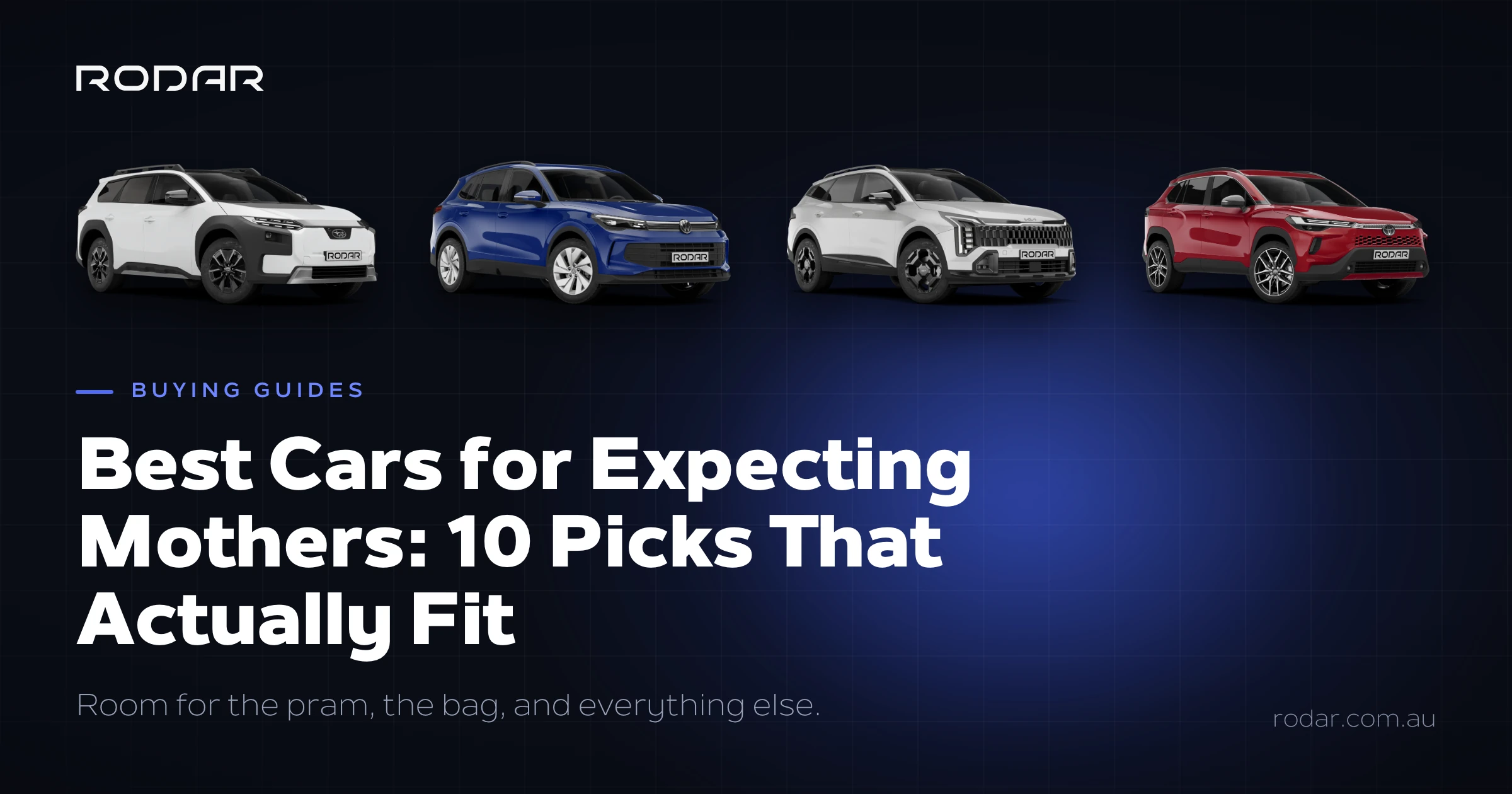
Somewhere around the third trimester the car stops being transport and starts being a logistics problem. A pram has to go in the boot, a capsule has to go in the back seat, and you have to be able to load both without it becoming the hardest part of the day.
The good news is that this is a solvable problem, and it comes down to four things rather than a hundred. These ten cars are judged on all four, with every ANCAP rating given with the year it was awarded and every boot figure traced to the manufacturer. When you have decided, Rodar can take your spec to our network of over 1,000 trusted automotive dealers and manufacturers, and getting competitive offers takes a few minutes.
What actually decides it
1. Getting in and out. The height you step up to, the angle the rear door opens to, and whether you can reach the far side of the back seat without leaning on the door frame. The easiest cars put the seat close to your standing hip height, so you slide across rather than climb or drop.
2. Room for the load, and how high you lift it. Boot litres get quoted most and help least. A full size travel system will fill several boots on this list on its own, before the nappy bag and the shopping. And the number nobody publishes matters more: how high the sill is, because you will be lifting a pram over it several times a day, at a point when lifting is harder than usual. A boot that opens itself is worth more than an extra fifty litres.
3. The back seat and the baby seat. A rear-facing capsule takes legroom from whoever sits in front of it, which is invisible in a showroom unless the capsule is fitted. Anchor points differ between grades. And if you have already chosen a pram and capsule, they may well decide the car rather than the other way round.
4. Peace of mind. Second row air vents, because a rear-facing capsule sits in the part of the car that cools last and an Australian summer is unforgiving. A quiet cabin, because a sleeping baby is the whole objective. And a current safety rating rather than one awarded years ago against older criteria.
For the longer view, our list for new families looks at the next five years. Expecting two? the twins list begins from a different question again.
The ten
Ordered loosely from the easiest to load upwards in size. Each one is scored on the four things above, in the same order.
Subaru Outback
A wagon rather than an SUV, which changes both ends of the problem: you sit down into it, and you lift things in at hip height instead of shoulder height.
ANCAP rates it five stars, awarded in 2021, covering the current generation.
- A wagon sill rather than an SUV one, so there is far less to lift over.
- 530 litres, and a wagon load space is longer and squarer than the same litres in an SUV.
- The roof stays high to the back doors, so leaning in to buckle a seat does not mean ducking.
- Rear air vents, and all wheel drive as standard.

Volkswagen Tiguan
The most load space on this list by a clear margin, in a car that is still easy to get in and out of.
ANCAP rates it five stars, awarded in 2024, covering vehicles built from March 2024. The rating runs to December 2031. Child occupant protection scored 88 per cent.
- Wide rear doors and a flat sill, so nothing has to be lifted over a lip.
- 652 litres, more than any other car here publishes on the same basis. A full size travel system leaves room for the shopping.
- A long cabin, so a rear-facing seat takes less from whoever sits in front.
- Power tailgate on the hybrids, and its ANCAP rating runs to December 2031.

Kia Sportage
The all-rounder. Nothing here is the outright best at any one thing, and very little is a compromise either.
ANCAP rates it five stars, awarded in 2021, covering vehicles from November 2021. Child occupant protection scored 87 per cent.
- One of the squarest rear door openings in the class, so you reach in rather than twist.
- 543 litres, 586 in the hybrid.
- A wide back seat, which is what decides whether a capsule and an adult fit side by side.
- A smart power tailgate that opens when you stand behind it, which matters when both arms are full. Rear air vents, though without a separate climate zone.

Hyundai Tucson
The Sportage's close relative, and the one to drive back to back with it, because the differences are small and personal.
ANCAP rates it five stars, awarded in 2021, covering all variants.
- Seat height lands where most people neither climb up nor drop down.
- 539 litres, 582 in the hybrid.
- Useful rear legroom for the outside size, which matters once a rear-facing seat pushes the front seat forward.
- A centre airbag between the front seats on every variant, and a smart power tailgate from Elite up.
A centre airbag between the front seats is standard on every variant, which is still not a given in this class.

Subaru Forester
Built around visibility, which is worth more than it sounds when you are reversing out with a pram in the boot and a capsule behind you.
ANCAP rates it five stars, awarded in 2025, covering the new generation, from June 2025, in petrol and hybrid.
- Large windows, slim pillars and rear doors that open close to square.
- 496 litres, 484 in the hybrid.
- An upright body, so there is room to stand in the door opening while you buckle.
- A kick-action power tailgate, and all wheel drive as standard.

Nissan Qashqai
The easiest car here to load a capsule into, because of one detail nobody puts in a brochure: how far the rear doors open.
ANCAP rates it five stars, awarded in 2022, covering vehicles built from October 2022. Child occupant protection scored 93 per cent.
- Rear doors open to close to ninety degrees, so you can get square to the seat instead of reaching around a frame.
- 479 litres on the Ti.
- Small enough to park in a tight hospital or shopping centre space, which is where the door angle earns its keep.
- Child occupant protection scored 93 per cent, the equal highest of its rating round. Power tailgate from the Ti-L up.
That child occupant score was the equal highest of any vehicle in its rating round, and safety assist scored 97 per cent.

Toyota Corolla Cross
The smallest car that still does all four jobs, and the one to look at if a mid-size SUV feels like more car than you want.
ANCAP rates it five stars, awarded in 2022, covering petrol and hybrid variants built from October 2022. The GR Sport is unrated.
- A higher hip point than a hatch without the step up of a mid-size SUV.
- 425 litres on the GXL front-wheel drive, which is a lot for the footprint. All wheel drive loses 35.
- An upright rear seat back, which suits a rear-facing capsule.
- Two rear air vents and two USB-C ports in the back. Hands-free tailgate on Atmos and above.

Toyota RAV4
The default answer, and it earns it here on door size and on what Toyota put in the back seat rather than on the badge.
On its safety rating. ANCAP's five star rating for the RAV4 is datestamped 2019, covers vehicles built to December 2025, and has expired. It does not describe the generation on sale now. We will tell you the rating status of the exact build you are quoted.
- Large rear door openings, which is what decides how far you have to twist.
- Toyota quotes up to 705 litres, but measured to the roof rather than to the parcel shelf like most of this list, so treat it as a different number rather than a bigger one.
- Hybrid and plug-in hybrid only, so the running costs suit a lot of short trips.
- Rear air vents, and a power tailgate up the range with a kick sensor on Cruiser and GR Sport.

Kia Sorento
A size up, for anyone who already knows a second child is the plan and would rather buy once.
ANCAP rates it five stars, tested against ANCAP's 2020 criteria, covering diesel variants only.
- Wide rear doors on a large body, so you stand in the opening rather than lean across it.
- 604 litres behind the second row in the plug-in hybrid, with the third row folded flat into the floor.
- The second row slides, so you can trade legroom against boot space day to day.
- A hands-free tailgate that also closes as you walk away, and third row vents with their own fan control on Sport, Sport+ and GT-Line.
Some ISOFIX restraints will fit in the third row, but ANCAP notes they have to be installed with care to sit correctly.

Kia Seltos
The value pick, and the most upright small SUV here, which is what makes a door opening useful rather than just tall.
ANCAP rates it five stars, awarded in 2019, covering all variants from October 2019.
- A tall, square door aperture rather than a sloping one.
- Boot figures for the current car are reported differently by different sources, so we will measure it with you rather than print a number we cannot stand behind.
- An upright rear seat back that suits a rear-facing capsule.
- Kia's seven year, unlimited kilometre warranty, which applies wherever you service it.

Comparison Table
Boot figures are seats up and quoted by the manufacturer, with the variant named where it changes. Prices are list prices before on-road costs.
| Vehicle | ANCAP | Price range | Boot, seats up | Second row air vents |
|---|---|---|---|---|
| Subaru Outback | five stars, 2021 | $48,990 to $62,690 | 530 litres | Yes |
| Volkswagen Tiguan | five stars, 2024 | $45,650 to $74,550 | 652 litres, the largest here | Not published |
| Kia Sportage | five stars, 2021 | $38,490 to $60,370 | 543 litres, 586 in the hybrid | Yes, though without a separate climate zone |
| Hyundai Tucson | five stars, 2021 | $39,100 to $59,850 | 539 litres, 582 in the hybrid | Not published |
| Subaru Forester | five stars, 2025 | $43,490 to $55,990 | 496 litres, 484 in the hybrid | Not published |
| Nissan Qashqai | five stars, 2022 | $45,640 to $54,140 | 479 litres on the Ti | Not published |
| Toyota Corolla Cross | five stars, 2022 | $37,440 to $52,340 | 425 litres on the GXL front-wheel drive. All-wheel drive loses 35 | Yes, two of them, with two USB-C ports |
| Toyota RAV4 | No current rating | $45,990 to $66,430 | Not published on a comparable basis | Yes |
| Kia Sorento | five stars, 2020 | $51,630 to $86,040 | 604 litres behind the second row in the plug-in hybrid | Third row vents with their own fan control on Sport, Sport+ and GT-Line |
| Kia Seltos | five stars, 2019 | $31,250 to $46,670 | Not published on a comparable basis | Not published |
Ordering in time
This is the part that catches people, and it is the easiest one to get right if you start early. A due date does not move. A delivery date can.
If the car is in stock somewhere in the network and your finance is already sorted, it can be 24 to 48 hours. Most of the time it is one week onwards. A specific grade in a specific colour can take longer again, and the popular family grades are exactly the ones that move.
Two things make the timing easier. Being flexible on colour is usually worth more than being flexible on anything else. And sorting the finance while your income is steady, rather than after leave starts, takes a variable out of the week the car finally becomes available.
Tell us your due date when you enquire. We will look at what is actually in stock across our network of over 1,000 trusted automotive dealers and manufacturers and tell you honestly what is reachable, including when the answer is that a different grade would arrive in time and your first choice will not.
Three we were asked about and left out
All three are good cars and we will happily source any of them. They came off this particular list on the criteria above.
The Mazda CX-30 has a 317 litre boot. It is lovely to sit in and the seat height is close to ideal, which is why it was on an earlier version of this list. Once room for the load counts as much as getting in, a boot that size is the wrong starting point for a pram and a week's shopping.
The current Hyundai Kona, on sale here since June 2023, is rated four stars by ANCAP across petrol, hybrid and electric, and protection of the driver's chest in the full width frontal test was assessed as Weak. The previous generation held five stars.
The Honda CR-V is also four stars, with a safety assist score of 68 per cent, and Australian cars are sold with Honda Sensing rather than the Honda Sensing 360 system available in some other markets. On Honda the benefit sits in a novated lease rather than a cash reduction, and we will tell you that plainly rather than imply otherwise.
Bring your capsule and your pram
Fit your own seat in the car before you buy it. Restraints vary a lot in how much room they take, and a capsule that fits easily in one car will push the front passenger forward in another of the same size. The same goes for the pram: length and shape decide whether it fits, not litres.
If you do not have them yet, tell us what you are planning to buy. We check fit and anchor points against the grades you are considering while we get you offers, and it often changes which grade people end up with.
How Rodar helps you buy any car on this list
The usual way of buying has you driving between dealerships, each with one allocation and one number to give you. That is a lot of weekends, and weekends are in short supply right now.
We do it the other way round. You tell us the make, model, grade and colour you want, and anything that has to fit. We put that to our network of over 1,000 trusted automotive dealers and manufacturers. Their offers come back side by side as drive-away figures, not list prices with the on-road costs left off. You pick the one you want.
From there we sort the finance across a panel of over 30 lenders, value your trade-in and roll it into the same number, and arrange delivery to your door. Most of our customers never set foot in a dealership. You are not invoiced a fee: the dealer who wins your business pays us a procurement fee, and it is built into the deal, so the price we quote is the price you pay.
You have enough to organise at the moment. If it helps, let us take the car off your list: tell us the capsule you have, the pram you like and your due date, and we will come back with the checking done and the offers lined up.
Whenever suits you, get your competitive offers, or read our FAQs first if you would rather see how it works. There is no rush from our end.
Rates and repayments are indicative only and subject to lender approval. Rodar Pty Ltd is an Authorised Credit Representative (555548) of Fintelligence Pty Ltd (ACL 511803).
Skip the dealership haggle
Once you've picked a model, Rodar does the sourcing, comparison and negotiation for you — so you get the right car at the right price.
Build your car now