Most Fuel Efficient SUVs in Australia 2026: The Best Small, Medium and 7-Seat Picks
The most fuel efficient SUVs for 2026 by size, with official fuel use and the AAA's real-world result side by side, and what changes on the…
 Tesla Model YElectric SUV
 BYD Atto 3Electric SUV
 BYD Sealion 7Electric SUV

We'll connect you with our wholesale network to get the best price for your car
Twelve hybrids ranked by official fuel use, with real-world results from the AAA for the ten it has tested, and which suit town or freeway.
← Top Reads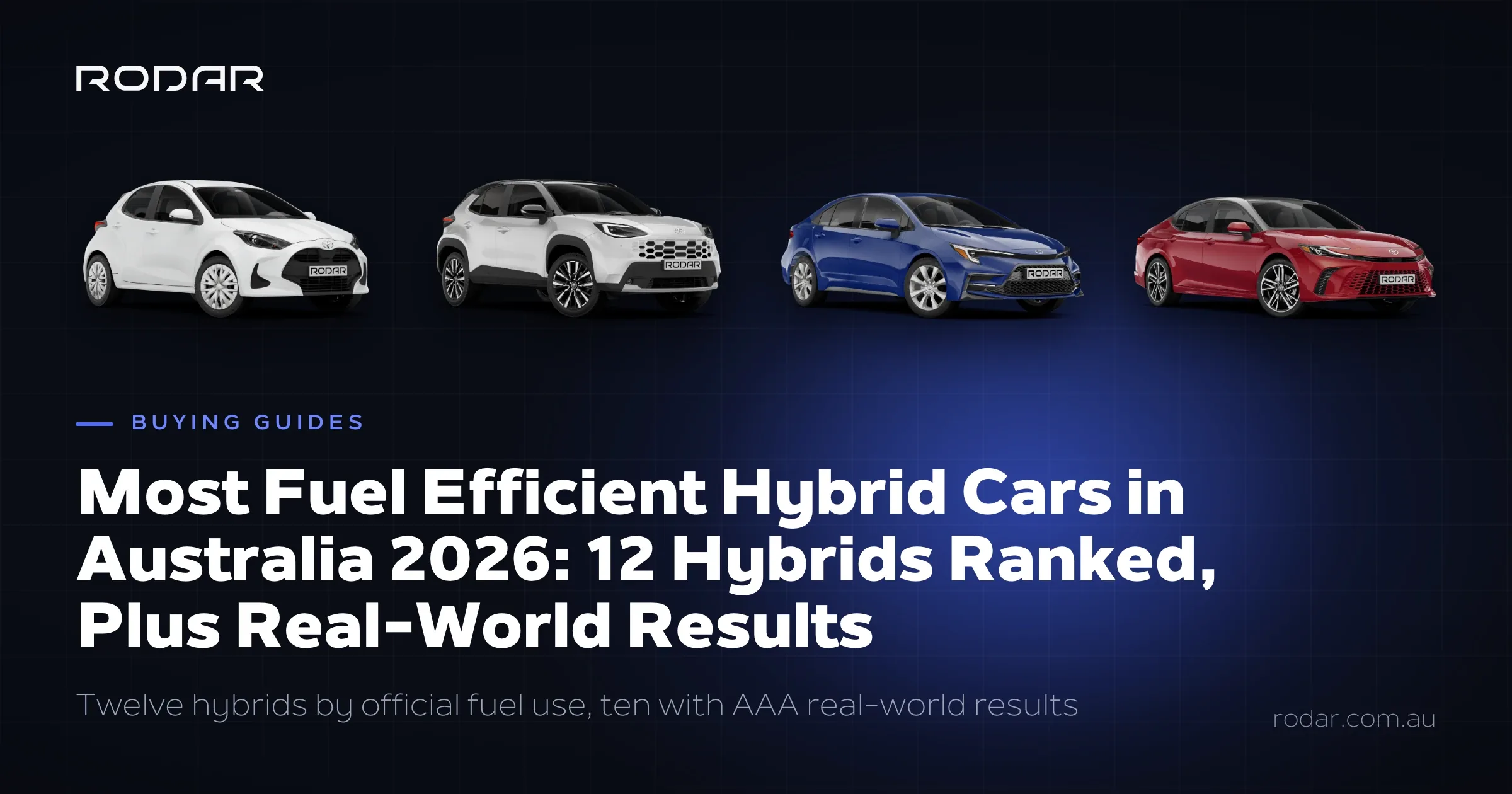
If fuel has been the cost you notice most this year, a hybrid is a sensible next step, and there are plenty of good ones to choose from. The tricky part is the number. The figure on the windscreen label comes from a laboratory, and what you get on your own school run or freeway commute can be quite different.
The good news is that most of these hybrids use very little fuel on the road too, and you can see how each one did before you buy. Below are twelve full hybrids, ranked on the official label, with the result from the AAA's Real-World Testing Program beside the ten it has tested. Then comes which suit town driving and which suit the freeway. For every fuel type, including electric and diesel, see our guide to the most fuel efficient cars in Australia. Once you have a shortlist, Rodar can put the exact grade you want to our dealer network and bring the offers back to you.
Each row names the grade the label figure belongs to, and the grade, model year and test date AAA used. Every label figure here is the combined figure on the ADR 81/02 test. AAA's own lab figure sits beside its road result, because some of its tests are of an earlier model year. All figures are litres per 100 km.
| Rank | Car (grade the label is for) | Label combined | Fuel (RON) | AAA tested | AAA lab | AAA road | AAA urban | AAA highway |
|---|---|---|---|---|---|---|---|---|
| 1 | Toyota Yaris (2026 builds) | 3.5 (earlier builds 3.3) | 91 | Ascent Sport, 2024 model, Oct 2025 | 3.3 | 3.6 | 3.2 | 3.9 |
| 2 | Toyota Yaris Cross (GX, GXL, Urban 2WD) | 3.8 (AWD 4.0, GR Sport 2WD 4.1) | 91 | GX AWD, 2024 model, Mar 2025 | 4.0 | 4.5 | 4.0 | 5.0 |
| 3= | Toyota Corolla (sedan) | 3.9 (hatch 4.0) | 91 | SX hatch, 2023 model, Mar 2024 | 4.2 | 4.2 | 4.0 | 4.8 |
| 3= | Hyundai i30 Sedan Hybrid | 3.9 | 91 | Sedan Hybrid, 2024 model, Apr 2025 | 3.9 | 4.6 | 4.2 | 5.4 |
| 3= | Hyundai Kona Hybrid | 3.9 | 91 | Hybrid, 2024 model, Mar to Apr 2025 | 3.9 | 5.2 | 4.7 | 6.4 |
| 6= | Toyota Camry (all grades) | 4.0 | 95 | Ascent, 2025 model, Jul 2025 | 4.0 | 4.8 | 4.6 | 4.9 |
| 6= | Toyota C-HR (GXL, Koba) | 4.0 | 91 | GXL, 2024 model, Nov 2024 | 4.0 | 4.4 | 4.3 | 4.6 |
| 8= | Toyota Corolla Cross (FWD) | 4.2 (AWD 4.4 to 4.5) | 91 | GX FWD, 2024 model, May 2024 | 4.2 | 4.5 | 4.3 | 5.0 |
| 8= | Honda Civic (e:HEV L) | 4.2 | 91 | Not tested | - | - | - | - |
| 10 | MG3 Hybrid+ | 4.3 | Check fuel flap | Not tested | - | - | - | - |
| 11 | Toyota RAV4 hybrid (2WD) | 4.5 | 95 | GX 2WD, 2026 model, Aug 2026 | 4.5 | 4.6 | 4.1 | 5.1 |
| Toyota RAV4 hybrid (AWD) | 4.6 | 95 | GXL AWD, 2026 model, Jul 2026 | 4.6 | 4.9 | 4.2 | 5.2 | |
| 12 | GWM Haval Jolion Hybrid | 5.1 | 91 | Lux Hybrid, 2025 model, Mar 2026 | 5.1 | 6.5 | 6.1 | 7.0 |
Read across a row and the order changes. On the label, the Kona Hybrid is joint third. On the road it used 5.2, ninth of the ten cars AAA tested here. The RAV4 GX 2WD, a medium SUV, is eleventh on the label and joint sixth on the road, level with the i30 Sedan Hybrid. The Corolla used exactly its lab figure, and the RAV4 GX 2WD came within 2 per cent of its own. At the other end, the Kona Hybrid used 33 per cent more than its lab figure.
The fuel label is measured in a laboratory on a set drive cycle, so every car is tested the same way. It shows urban, extra-urban and combined figures. Most lists, including ours, rank on the combined figure.
The AAA's Real-World Testing Program drives each car on public roads, on a 93 km loop around Geelong with urban, rural and highway sections. It gives a combined road figure plus a figure for each section. Those section figures are where the town and freeway picks below come from.
From 1 July 2026, newly approved models supplied for the first time carry a new label under ADR 81/03. It is based on the newer WLTP laboratory test, which tests hybrids with both a charged and a depleted battery. Every new light vehicle moves to the new label from 1 July 2028. Until then, two cars side by side in a showroom may carry labels from different tests, so compare figures from the same test. Every car on this list was on sale before 1 July 2026, which is why every label figure here is on the ADR 81/02 test.
A model's headline figure usually belongs to its most efficient grade, often the 2WD. The Yaris Cross is 3.8 in the GX, GXL and Urban 2WD, 4.0 in AWD and 4.1 in the GR Sport 2WD. The Corolla Cross is 4.2 in FWD, 4.4 in the GXL and Atmos AWD, and 4.5 in the GR Sport AWD. The C-HR's 4.0 belongs to the GXL and Koba, which use a 1.8-litre hybrid, while the GR Sport uses a 2.0-litre hybrid with AWD. Check the figure for the grade you are buying, not just the model.
Most hybrids here run on 91 regular unleaded. The Camry and the new RAV4 need 95-octane premium, which costs more at the pump. Sources differ on whether the MG3 Hybrid+ needs 91 or 95, so check its fuel flap. What you spend is litres used times the price per litre. So a car on 95 that uses a little less can cost about the same to run as one on 91 that uses a little more. For the dollars, including servicing and insurance, see our guide to the cars that cost least to run.
The same word covers four different set-ups, and they save very different amounts of fuel.
Toyota sells the Yaris, Yaris Cross, Corolla, Corolla Cross, C-HR and Camry only as hybrids, and the RAV4 as a hybrid or plug-in hybrid. So at Toyota the question is which hybrid and which grade, not whether to go hybrid.
The Toyota Yaris uses the least fuel of any hybrid here, on the label and on the road. It is sold only as a hybrid, rated at 3.5 on 2026 builds and 3.3 on earlier ones. AAA's Ascent Sport used 3.6 on the road, 3.2 in town and 3.9 on the highway, the lowest highway figure of the cars AAA tested on this list. It runs on 91 and suits anyone who wants a light hatch and the smallest fuel bill.
The Toyota Yaris Cross has the lowest label of any SUV here, at 3.8 in the GX, GXL and Urban 2WD. The AWD grades are 4.0 and the GR Sport 2WD is 4.1. AAA tested a GX AWD, which used 4.5 on the road against a lab figure of 4.0. An earlier AAA test of a 2021 GXL 2WD returned 4.3 against 3.8. Choose a GX, GXL or Urban 2WD for the headline figure. It runs on 91. For more small SUVs, see our best small SUVs.
The Toyota Corolla sedan is rated at 3.9 and the hatch at 4.0, in every grade. The sedan comes as the Ascent Sport and SX, and the ZR is hatch only. In AAA's test, an SX hatch used exactly its lab figure of 4.2, the closest match of any car AAA tested here. Its 4.8 highway figure is the third lowest of the cars AAA tested here, after the Yaris and C-HR. It runs on 91.
The Hyundai i30 Sedan Hybrid matches the Corolla sedan's 3.9 label. AAA's test returned 4.6 on the road, 4.2 in town and 5.4 on the highway. It runs on 91. Hyundai is advertising runout offers on select i30 Sedan Hybrids while stocks last, so check stock early if it is on your list.
The Hyundai Kona Hybrid is the small SUV level with the Corolla on the label. On AAA's test it used 4.7 in town, a good result for a small SUV, and 6.4 on the highway. With that split, it suits mostly town driving best. It runs on 91.
The Toyota Camry is rated at 4.0 in every grade and is sold only as a hybrid. AAA's Ascent used 4.8 on the road, and it barely changed between town (4.6) and highway (4.9). For a family sedan that spends a lot of time on the freeway, that steadiness is useful. It needs 95.
The Toyota C-HR GXL and Koba use a 1.8-litre hybrid and carry a 4.0 label. The GR Sport uses a 2.0-litre hybrid with AWD instead. On AAA's highway section the GXL used 4.6, the best result after the Yaris among the cars AAA tested here. It used 4.4 on the road overall and runs on 91.
The Toyota Corolla Cross is rated at 4.2 in its FWD grades, 4.4 in the GXL and Atmos AWD, and 4.5 in the GR Sport AWD. AAA's GX FWD used 4.5 on the road, 7 per cent over its lab figure, with 4.3 in town and 5.0 on the highway. It runs on 91.
The Honda Civic e:HEV L is a full hybrid rated at 4.2, and it runs on 91. AAA has not road-tested it, so there is no road figure to set beside the label yet. Honda is one of the brands where any saving comes through a novated lease.
The MG3 Hybrid+ is the lowest-priced car on this list, going by the prices on our car pages. It is rated at 4.3. Sources differ on whether it needs 91 or 95, so check the fuel flap. AAA has tested the petrol MG3 and MG's ZS Hybrid+, but not the MG3 Hybrid+, so there is no road figure for it yet.
The Toyota RAV4 hybrid is rated at 4.5 in 2WD and 4.6 in AWD, and it needs 95. It has the most recent AAA results of any car here, tested in July and August 2026. The GX 2WD used 4.6 on the road, 2 per cent over its lab figure, and the GXL AWD used 4.9. For a medium SUV, that GX 2WD result matches the i30 Sedan Hybrid. Our RAV4 and CX-5 comparison covers its fuel use in more detail.
The GWM Haval Jolion Hybrid is rated at 5.1. AAA tested a 2025 Lux Hybrid in March 2026. It used 6.5 on the road against a lab figure of 5.1, with 6.1 in town and 7.0 on the highway. It runs on 91.
Every hybrid AAA tested here used more fuel on the highway than in town. A petrol car can be the other way round: AAA's 2022 petrol Corolla used 7.9 in town and 5.5 on the highway. So the right hybrid depends on where you do most of your kilometres.
A bigger car costs less fuel than you might expect. On the road, the RAV4 GX 2WD used 4.6, the same as the i30 Sedan Hybrid and less than the Kona Hybrid's 5.2. If your household needs a medium SUV, you give up very little fuel to get one. For SUVs across every fuel type, see our guide to the most fuel efficient SUVs. If your commute is long and comfort matters as much as fuel, our guide to the best cars for long commutes covers the rest.
A plug-in hybrid has a bigger battery that you charge from a power point. It carries an energy consumption label, and its combined fuel figure takes the electric range into account, so the label assumes you start with a charged battery. Charge it most days and it can use very little petrol. Once the battery is flat, it works as a regular hybrid that carries the extra weight of its battery pack. That is why a plug-in's label cannot be compared with the figures above.
The RAV4 also comes as a plug-in hybrid. Our guide to the best hybrid SUVs explains how the two kinds differ. If you can charge at home every night, an electric car is worth a look as well.
A mild hybrid helps the petrol engine but cannot drive the car on electricity. The Suzuki Swift Hybrid uses a 12-volt system. In AAA's test, a Swift Hybrid Plus used 5.2 on the road against a lab figure of 4.0, with 6.3 in town and 4.8 on the highway. That is the same pattern as the petrol Corolla above, the reverse of the full hybrids here, and it is why the Swift is not ranked with them. For petrol cars, see our guide to the most fuel efficient non-hybrid cars.
You may also see the Toyota Prius on other lists. Toyota discontinued it in Australia in 2022, so it is not on sale new here.
Choosing a hybrid by the way you drive takes more care than reading one number off a label. You have done that work now, and the right grade will keep your fuel bill down for years.
We can take it from there. Tell us the grade the figures point to, whether that is a Yaris Cross GX 2WD, a C-HR GXL or a Corolla sedan, and we will go and find it. When the car is in stock and your finance is already sorted, delivery can take as little as 24 to 48 hours. Most cases take one week onwards, depending on the model and stock availability across our network of over 1,000 trusted automotive dealers and manufacturers.
If you are replacing a petrol car, we can include your trade-in in the same deal. We can also arrange finance alongside the car: a car loan, or a novated lease if your employer offers one. A hybrid or plug-in hybrid on a new novated lease does not get the FBT exemption that eligible electric cars do. Our guide to the best cars for a novated lease explains what that means for a hybrid, and whether novated leasing is worth it covers the basics. For the Honda Civic, any saving comes through a novated lease. For the other brands here, our guide to getting a good price on a new car shows what a competitive drive-away price looks like.
When you are ready, get your competitive offers, or read our FAQs first. Take your time. There is no pressure either way.
Rates and repayments are indicative only and subject to lender approval. Rodar Pty Ltd is an Authorised Credit Representative (555548) of Fintelligence Pty Ltd (ACL 511803).
Once you've picked a model, Rodar does the sourcing, comparison and negotiation for you — so you get the right car at the right price.
Build your car nowYou tell us the model, grade and colour you want, for example a Corolla SX sedan or a RAV4 GX 2WD hybrid. We put it to our network of over 1,000 trusted automotive dealers and manufacturers, and their drive-away offers come back to you side by side. You pick one, and we sort finance, your trade-in and delivery to your door. The dealer who wins your business pays us a procurement fee, and it is built into the deal, so the drive-away price we quote is the number you pay. It is the most efficient route to a competitive drive-away price, because the dealers come to you. On a Honda, any saving comes through a novated lease, and our fee sits inside the lease arrangement.
Of the hybrids here, the Toyota Yaris has the lowest label figure, 3.5 L/100km on 2026 builds, and it also used the least in AAA's road test, at 3.6. For an SUV, the Yaris Cross GX, GXL and Urban 2WD have the lowest label, at 3.8. On the road, the C-HR GXL used 4.4, a little less than the 4.5 of the Yaris Cross AWD that AAA tested.
Yes, but less than in town. Every hybrid AAA tested here used more on its highway section than in town, and the gap varies a lot. The Camry went from 4.6 L/100km in town to 4.9 on the highway, while the Kona Hybrid went from 4.7 to 6.4. If most of your driving is on the freeway, compare the highway figures rather than the label.
The label comes from a laboratory test. On real roads, your driving style, the traffic and the weather all change the result. In AAA's road testing, nine of the ten hybrids here used more than their lab figure, by up to 33 per cent, and the Corolla matched it. Check that the label belongs to your grade as well, because AWD and larger-engine grades are rated higher.
No. A standard hybrid charges its own battery as you drive, and you fill it with fuel like any other car. Only a plug-in hybrid needs charging from a power point, and it needs it regularly to get near its label.
No. It is a mild hybrid. Its 12-volt system helps the petrol engine, but it cannot drive the car on electricity alone, so it is not ranked with the full hybrids here. In AAA's test, a Swift Hybrid Plus used 5.2 L/100km on the road against a lab figure of 4.0.
Toyota covers the hybrid battery for five years, and adds five more, up to 10 years in total, on a privately used car that is serviced to the schedule and has a Hybrid Health Check every year. For any other brand, check the battery terms with the maker before you buy.
Most here do not. The Yaris, Yaris Cross, Corolla, Corolla Cross, C-HR GXL, i30 Sedan Hybrid, Kona Hybrid, Civic e:HEV L and Jolion Hybrid run on 91. The Camry and the new RAV4 need 95, which costs more at the pump. Sources differ on the MG3 Hybrid+, so check its fuel flap.
Only if you charge it often. A plug-in's label assumes you start with a charged battery. Once the battery is flat, it runs as a regular hybrid that carries the extra weight of its battery pack. If you can plug in most days, it can use very little petrol. If you rarely can, a standard hybrid is the simpler choice.
The most fuel efficient SUVs for 2026 by size, with official fuel use and the AAA's real-world result side by side, and what changes on the…
The petrol cars that use the least, ranked by official fuel use with the AAA's real-world result beside each car it has tested, plus the hy…
Hybrids ranked by official fuel use with real-world results from the AAA beside them, plus plug-in hybrids and electric cars, each on its o…