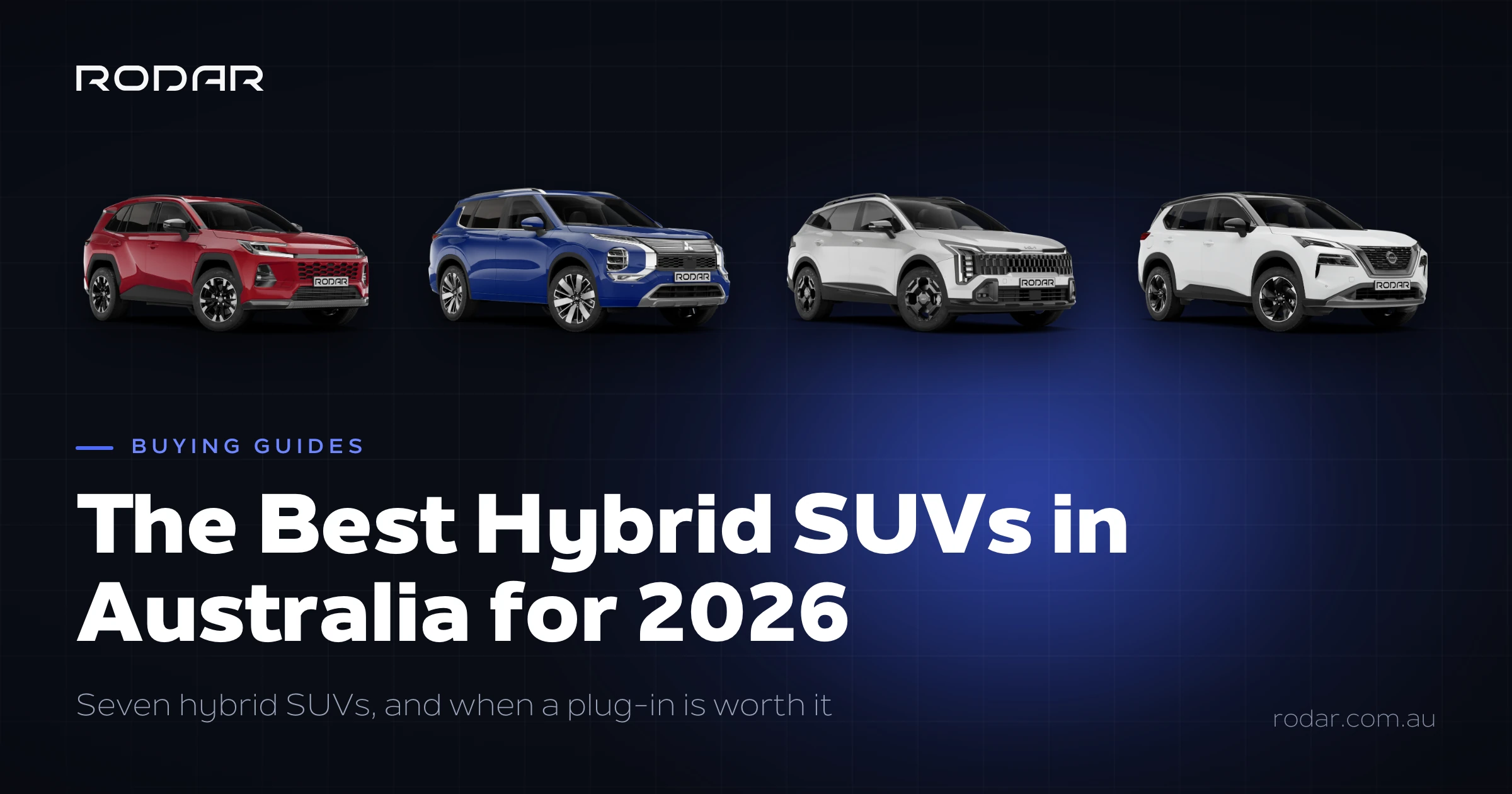
A hybrid SUV is a very comfortable middle ground. You use noticeably less fuel, especially around town, and you do not have to change how you live. There is no charging to plan unless you want it, and the car drives quietly and smoothly in traffic.
The choice has grown quickly, and the names can be confusing, so it is worth being clear on one thing first: the kind of hybrid you want. After that, there are seven SUVs below worth your shortlist. When you have narrowed it down, Rodar can take the car you choose to our network of over 1,000 trusted automotive dealers and manufacturers and bring the offers back to you.
Standard hybrid or plug-in hybrid?
Both combine a petrol engine with an electric motor and a battery. The difference is the size of the battery and whether you plug it in.
- Standard hybrid. A small battery charges itself as you drive and brake. You never plug it in. The electric motor helps the petrol engine, and at low speeds it can drive the car on its own for short stretches. The savings are largest in stop-start traffic.
- Plug-in hybrid (PHEV). A much bigger battery that you charge from a power point or wall charger. On a full charge you can drive a real distance on electricity alone, and the petrol engine takes over when the battery runs down. PHEVs cost more to buy.
A simple way to decide: if you can charge at home and most of your daily driving fits the electric range, a PHEV can run mostly on electricity. If you cannot charge at home, or you mainly want lower fuel bills with nothing new to learn, a standard hybrid is the easier fit.
The best hybrid SUVs in Australia for 2026
The benchmark: Toyota RAV4
The RAV4 was the second best-selling SUV in Australia in the first half of 2026, behind only the Tesla Model Y, even through a changeover to the new generation.

- Hybrid or plug-in. Toyota no longer sells a petrol-only RAV4. The hybrid starts at $45,990 plus on-road costs for the GX 2WD. The plug-in hybrid, Toyota's first in Australia, starts at $58,840 for the XSE 2WD.
- Warranty. Five years, unlimited kilometres, with engine and driveline cover extending to seven years when serviced on schedule.
- Wait. Demand is high, so the grade and colour you want is usually what decides the wait.
The all-rounder: Hyundai Tucson Hybrid
A roomy, well-equipped medium SUV, and Hyundai has built its 2026 range heavily around the hybrid.

- Drivetrain. A 1.6-litre turbo hybrid making 172 kW and 367 Nm, in front- or all-wheel drive.
- Fuel. 5.3 L/100km on the official combined cycle.
- Warranty. Seven years, unlimited kilometres, when scheduled servicing is completed on time within Hyundai's network.
The practical choice: Kia Sportage Hybrid
Related to the Tucson under the skin, with its own styling and a spacious cabin. The hybrid now starts at the entry S grade.

- Price. From $44,450 plus on-road costs for the S Hybrid FWD, up to $60,370 for the GT-Line Hybrid AWD.
- Drivetrain and fuel. 173 kW and 367 Nm, using 4.9 to 5.3 L/100km depending on the variant.
- Towing. 1,900 kg braked, more than the petrol Sportage.
- Warranty. Seven years, unlimited kilometres, for private buyers.
The value play: GWM Haval H6 Hybrid
If budget comes first, the H6 gives you a lot of equipment for the money. It comes as a standard hybrid and as a plug-in hybrid, so you can choose either approach in the same car.

- No plug needed. The standard hybrid's small battery recharges as you drive.
- Warranty. Seven years, wherever you service it.
The different one: Nissan X-Trail e-POWER
The e-POWER works differently from every other car here. Its 1.5-litre turbo petrol engine never drives the wheels. It only makes electricity, and electric motors do all the driving.

- How it feels. Smooth and quiet, much like an electric car, and you never plug it in.
- Seats. The e-POWER is a five-seater. It cannot be ordered with seven seats.
The premium plug-in: Mazda CX-60 P50e
You may see the Mazda CX-5 on older hybrid lists. The current CX-5 is sold in Australia with a 2.5-litre petrol engine only. Mazda's plug-in hybrid SUV is the CX-60 P50e, and it suits buyers who want a more upmarket cabin.

- Electric range. 76 km on electricity alone, on the NEDC test.
- Drivetrain. A 2.5-litre petrol engine and electric motor with a combined 241 kW.
The seven-seat plug-in: Mitsubishi Outlander PHEV
A plug-in hybrid with enough electric range for many daily commutes, and a petrol engine for the long trips.

- Electric range. 84 km on the WLTP test, from a 22.7 kWh battery.
- Seats. Only the Aspire grade has seven seats, at $66,790 plus on-road costs. The ES, Exceed and Exceed Tourer are five-seaters.
- Warranty. Up to 10 years or 200,000 km, when serviced on schedule within Mitsubishi's network.
What to compare beyond the badge
- How you really drive. Hybrids save the most in town. On long highway runs the saving shrinks.
- Where you can charge. A PHEV only earns its higher price if you plug it in most days.
- Space. Check the boot with your pram, golf clubs or dog in mind, and sit in the back seat yourself.
- Warranty and servicing. Several brands here tie their longest warranty to servicing on schedule in their own network, so check the conditions.
- Safety. Look for a current five-star ANCAP rating, and check the year it was awarded.
Hybrids, plug-ins and novated leasing
You can put a standard hybrid or a plug-in hybrid on a novated lease if your employer offers salary packaging. Fringe benefits tax applies to both in the usual way.
Plug-in hybrids used to be exempt from FBT, but that exemption ended for new arrangements from 1 April 2025. A PHEV already covered by a binding commitment before that date keeps it. The exemption now applies only to eligible fully electric cars, and changes to it from 1 April 2027 have been announced, subject to legislation. Our guide to the best electric cars explains those. This is general information only, so please get advice for your own situation before you decide.
How Rodar helps you buy a hybrid SUV
The popular hybrids are in high demand, so finding a good price on the exact grade and colour you want takes time. We do that part for you. You tell us the make, model, grade and colour, and we put it to our network of over 1,000 trusted automotive dealers and manufacturers. Their drive-away offers come back side by side, and you pick the one you want.
From there we sort the finance across a panel of over 30 lenders, value your trade-in and arrange delivery to your door. If the car is in stock and your finance is sorted, it can be 24 to 48 hours. Most of the time it is one week onwards, depending on the model and what is available across the network. If you are weighing up a loan against a novated lease, we can walk you through both.
There is no wrong answer on this list. Tell us how you drive and whether you can charge at home, and we will help you land on the right one.
Whenever you are ready, get your competitive offers, or read our FAQs first if you would like to see how it works. No pressure either way.
Rates and repayments are indicative only and subject to lender approval. Rodar Pty Ltd is an Authorised Credit Representative (555548) of Fintelligence Pty Ltd (ACL 511803).
Skip the dealership haggle
Once you've picked a model, Rodar does the sourcing, comparison and negotiation for you — so you get the right car at the right price.
Build your car now