Most Fuel Efficient SUVs in Australia 2026: The Best Small, Medium and 7-Seat Picks
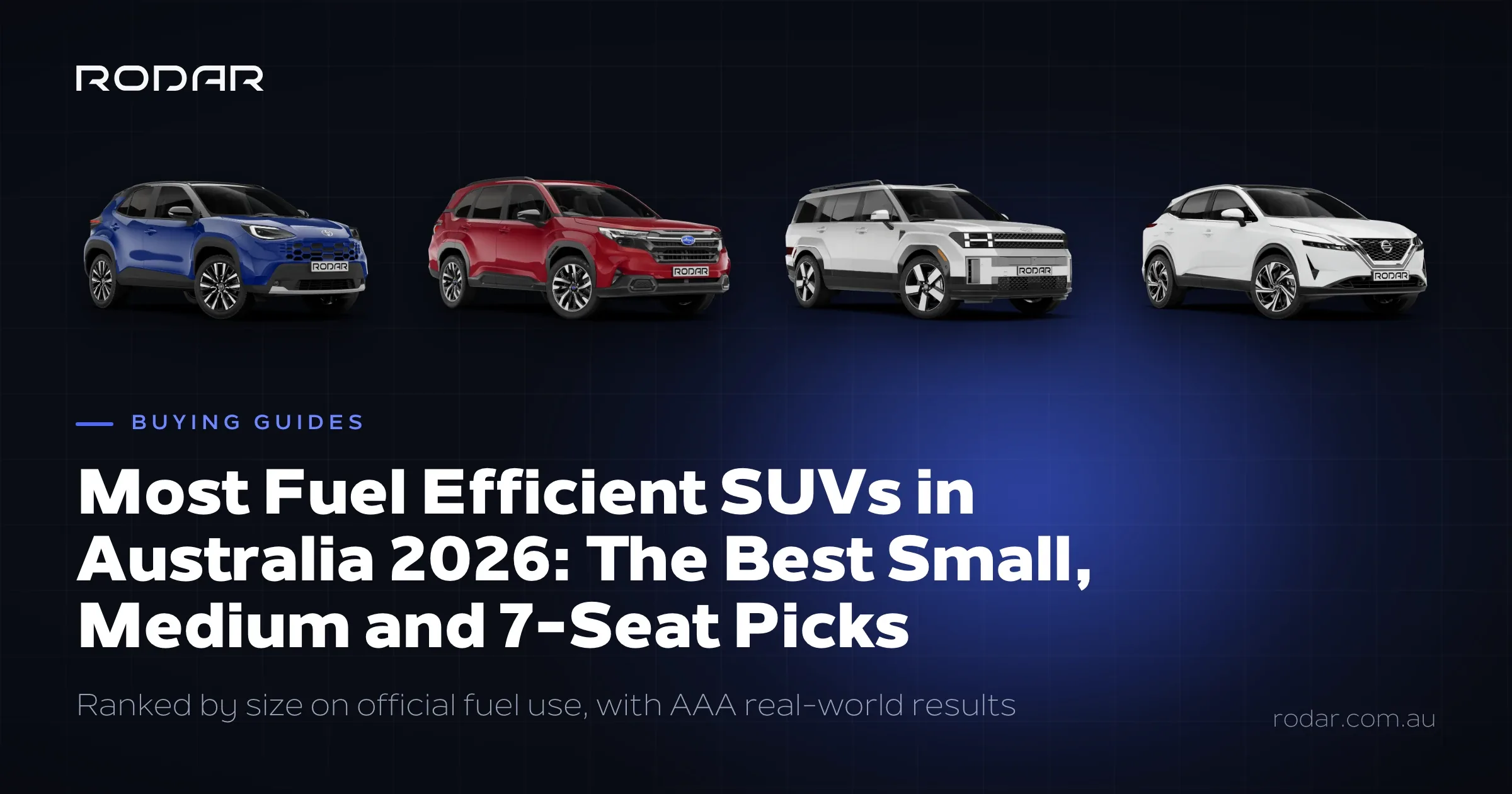
The most fuel efficient SUVs for 2026 by size, with official fuel use and the AAA's real-world result side by side, and what changes on the…
 Tesla Model YElectric SUV
 BYD Atto 3Electric SUV
 BYD Sealion 7Electric SUV

We'll connect you with our wholesale network to get the best price for your car
The petrol cars that use the least, ranked by official fuel use with the AAA's real-world result beside each car it has tested, plus the hybrid sums done on one car.
← Top Reads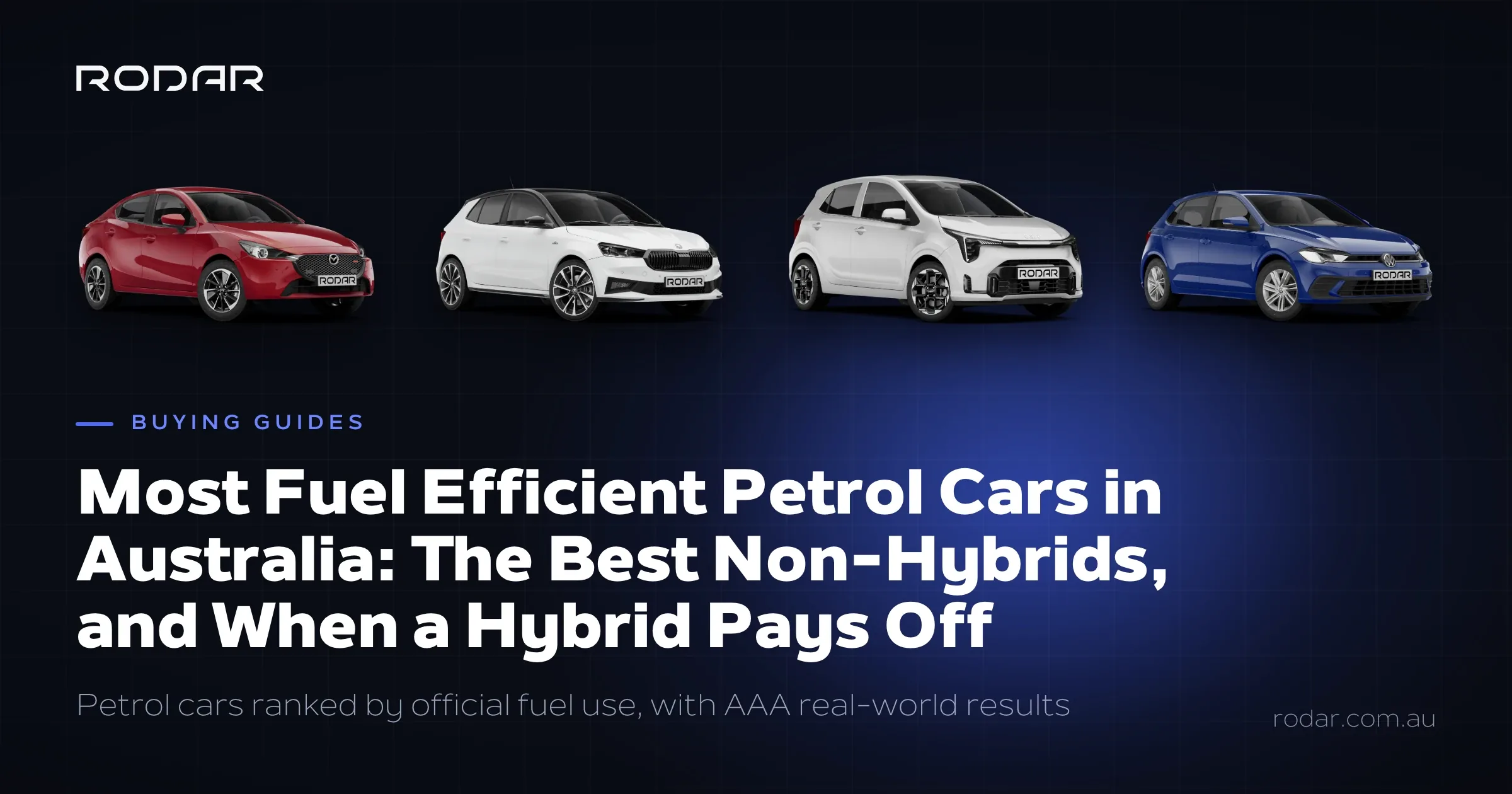
If you have priced the hybrid version of a small car and decided the extra money does not add up for you, that is a sound call for a lot of people. You might cover modest distances, spend most of your time on the highway, want a manual, or simply want the car you like at the price you have set. What you want now is the petrol car that genuinely uses the least, and some confidence that the number on the windscreen is real.
The good news is that the field is small and the facts are public. Below are the most fuel efficient petrol cars in Australia you can buy new, ranked on the official label figure, with the AAA's real-world result beside it wherever AAA has tested the car. For each car you get its fuel grade, litres a year, safety rating status and price. Then we run the hybrid sums on one car, so you can check your decision against how you drive. If you would like every fuel type, ranked, start there.
Label figures are the official combined figure from a laboratory test, in L/100km. Real-world figures come from the AAA's Real-World Testing Program. Where we say no AAA result, AAA's published records, checked on 30 October 2026, hold none for the current car.
The order follows the label figure for the named grade, because it is the one number every car has. Where two cars tie, the car confirmed on 91 goes first. Every label figure here is the ADR 81/02 combined figure, except the MG3, where MG gives 6.0 combined without naming the standard.
Litres a year is the label figure multiplied by 150, for 15,000 km. At the national average of 238.4c a litre in the week ending 25 October 2026, every 100 litres of 91 costs $238.40. Premium 95 costs more a litre, so a car on 95 costs more to run than its litres suggest.
Safety status is from ANCAP's rating pages, checked on 30 October 2026. Prices are for the named grade, including estimated on-road costs, as at 30 October 2026. Skoda publishes its own drive-away prices, so we do not print a Fabia price.
The Mazda2 shares the lowest label figure here with the Fabia, and it is the lower of the two on fuel grade: it runs on 91. It is a light hatch or sedan with a 1.5-litre four-cylinder and a 44-litre tank. Mazda dropped the manual for 2025, so it is automatic only.
The numbers. Label 5.0, AAA real world 6.8. That is 35 per cent over the label, the widest gap in its round of testing. 750 litres a year on the label, 1,020 at the AAA figure. ANCAP: rated in 2015, expired December 2022, so it is now unrated. From $31,000 for the G15 Evolve.
Choose it for the lowest label figure on regular unleaded in a small, simple car.
The Skoda Fabia matches the Mazda2 on the label. It has a 1.0-litre turbo three-cylinder with 85 kW and a seven-speed DSG automatic. Skoda's MY26 spec sheet lists 5.9 urban and 4.5 extra-urban, and premium unleaded, 95 RON minimum. The tank is 42.5 litres.
The numbers. Label 5.0. No AAA result. 750 litres a year, of 95. ANCAP: five stars, rated in 2021 and expiring December 2027, for all variants built from March 2022. Skoda's warranty is 7 years, wherever the car is serviced.
Choose it for the Mazda2's label figure with a turbo and a dual-clutch, if you are happy to buy 95.
The Kia Picanto is the lowest-priced car here. The Sport comes with a five-speed manual or a four-speed automatic, and the GT-Line is automatic only. The manual is rated 5.4 and the automatic 6.0, both on 91.
The numbers. Label 5.4 manual, 6.0 automatic. AAA real world 6.7, tested against the automatic's 6.0. 810 litres a year for the manual, 900 for the automatic. ANCAP: rated in 2017, expired December 2023, so it is now unrated. From $22,660 for the Sport. Kia's warranty is 7 years, unlimited kilometres.
Choose it if you want a manual, the lowest price on this list, or both.
The Volkswagen Polo Life matches the Picanto manual on the label, with a current five-star rating. Every grade except the GTI has a 1.0-litre turbo and a seven-speed automatic. All need 95 and have a 40-litre tank.
The numbers. Label 5.4. No AAA result. 810 litres a year, of 95. ANCAP: five stars, rated in 2022 and expiring December 2028, for Australian cars built from February 2022. From $34,610 for the Life.
The Mazda3 G20 is a small car within a litre of the Mazda2 on the label. Its 2.0-litre four-cylinder makes 114 kW through a six-speed automatic, on 91. The sedan is rated 5.8, with 7.2 urban and 5.0 highway, and Mazda quotes 5.9 for the hatch. The sedan's tank is 51 litres.
The numbers. Label 5.8 sedan, 5.9 hatch. No AAA result for the current-label G20. AAA tested a 2021-build G20 Pure at 6.4 on a 6.2 label, and a 2.5-litre G25 Evolve at 7.4 on 6.6. 870 litres a year for the sedan. ANCAP: rated in 2019, expired December 2025. From $35,450 for the G20 Pure.
The Kia K4 sedan's updated 2.0-litre with Kia's IVT, a continuously variable transmission, took it from 7.4 to 6.0 on the label. The hatch is 6.1. Both run on 91, with a 47-litre tank.
The numbers. Label 6.0 sedan, 6.1 hatch. AAA real world 7.0 for the S hatch, against its 6.1 label. 900 litres a year for the sedan. ANCAP: five stars, rated in 2025 and expiring December 2031, for every grade except the S without the Safety Pack, which has a separate four-star rating. From $35,950 for the S and $38,110 for the S Safety Pack.
We would choose the S Safety Pack. It adds Kia's upgraded FCA 2 emergency braking, with junction crossing support, plus dual-zone climate control and a digital instrument cluster, and it carries the five-star rating.
The MG3 Vibe is the lowest-priced car here after the Picanto. MG quotes a 1.5-litre petrol with 81 kW and 142 Nm through a CVT. It shares its name with the MG3 Hybrid+, so you can see the hybrid's premium on one badge: the Hybrid+ Excite is $30,690 against $27,600 for the petrol Excite, a $3,090 gap.
The numbers. Label 6.0, AAA real world 6.7, 12 per cent over. 900 litres a year. MG's MG3 page does not state the fuel grade, so check the fuel flap or the owner's manual. ANCAP: four stars, rated in 2025, for cars built from 30 April 2025. Cars built before then carry three stars. From $25,540 for the Vibe. MG's warranty is 10 years, with conditions.
Choose it for a low price with an automatic. Check the build date on any car offered.
The Hyundai i30 sedan's 2.0-litre petrol base grade is rated 6.1 on 91, with 8.5 urban and 4.7 highway. It has a CVT and a 47-litre tank.
The numbers. Label 6.1, AAA real world 6.2. 915 litres a year. ANCAP: three stars, rated in 2024 and expiring December 2031, for petrol and hybrid sedans built from June 2023, excluding the Sedan N. From $34,050. Hyundai's warranty is 7 years, unlimited kilometres, with the last two years conditional on on-time scheduled servicing within Hyundai's network.
The windscreen figure comes from a laboratory test, run the same way for every car so they can be compared. Skoda's spec sheet says it plainly: "Advertised figures are meant for comparison amongst vehicles only."
The independent check is the AAA's Real-World Testing Program. It is federally funded, and every car is driven on the same 93 km loop of public roads in and around Geelong. The Mazda2 used 35 per cent more than its label, the Picanto 11 and the MG3 12. The i30 petrol came within 1 per cent.
On the road, the Picanto, the MG3 and the Mazda2 finished within 0.1 L/100km of each other, after a full litre separated them in the lab. If you are choosing between those three, choose on price, transmission, space or safety rating. Fuel will not separate them.
Body shape did not decide it either. In AAA's August 2025 round, the Volkswagen T-Cross, a small SUV, used 5.8 against a 5.6 label, a litre less than the Mazda2 used on the road. If you are open to an SUV, see the most fuel efficient SUVs.
For your budget, use the AAA figure where there is one. A Mazda2 at 15,000 km a year uses 270 litres more at the AAA figure than on the label, which is $643.68 at 238.4c a litre.
Two of the most efficient cars here, the Fabia and the Polo, need premium unleaded, 95 RON at minimum. Use the minimum octane the maker states on the fuel flap and in the owner's manual. Because 95 costs more a litre than 91, a Fabia's 750 litres a year cost more than a Mazda2's 750.
How much more depends on the gap between 91 and 95 where you fill up. Take the difference between the two prices at your usual station and multiply it by the litres above. That is your yearly premium for the better label figure.
On the Picanto Sport, the manual is rated 5.4 and the automatic 6.0. That 0.6 gap is 90 litres a year at 15,000 km, or $214.56 at 238.4c. It is also bigger than the gap between the Picanto automatic and the Mazda3 G20 sedan, which uses less on the label at 5.8.
Of the eight cars here, the Picanto Sport is the only one sold with a manual. Mazda dropped the manual Mazda2 for 2025, and the Fabia, Polo, MG3, K4 and i30 sedan are automatics.
A frugal car with a small tank can still mean frequent stops, which matters if you drive long regional distances. The Polo holds 40 litres, the Fabia 42.5 and the Mazda2 44, against 47 for the K4 and the i30 sedan and 51 for the Mazda3 sedan. For comfort on long drives, see the best cars for long commutes.
The i30 sedan is sold as a 2.0-litre petrol and a 1.6-litre hybrid, both on 91. The base petrol is $34,050 and the hybrid $37,920, including estimated on-road costs, a $3,870 gap. On the label, the petrol is 6.1 and the hybrid 3.9. On AAA's road test, the petrol used 6.2 and the hybrid 4.6, a gap of 1.6 L/100km. The sums below use the label gap of 2.2. On AAA's 1.6, the payback at 15,000 km stretches to 6.8 years.
At 238.4c a litre, this is what the hybrid saves, and how long it takes to cover the $3,870:
Two things move these numbers. If the fuel price falls, every saving above shrinks with it and the payback stretches. A drive-away offer on either grade can also change the $3,870. The hybrid has a different engine and gearbox too, so check what else changes between the two grades.
The lab also splits the combined figure into urban and highway cycles. The i30 petrol is 8.5 urban and 4.7 highway. The hybrid is 2.8 urban and 4.0 highway. So in town the hybrid uses 5.7 L/100km less, and on the highway cycle 0.7 less.
At 15,000 km of highway-cycle driving, that 0.7 is 105 litres, or $250.32 a year, and the $3,870 would take more than 15 years to come back. At 15,000 km of urban-cycle driving, the payback is under two years. On long highway runs the saving is smaller.
Most driving sits between the two. If yours is mostly highway, a petrol car holds up well on fuel alone. If it is mostly stop-start, the hybrid's case is strong, and our guide to fuel efficient hybrids is the next place to look. The same check works on any badge sold both ways, such as the MG3. For servicing, insurance and tyres as well as fuel, see what each car costs to run.
Some cars badged hybrid are mild hybrids. Suzuki describes the current Suzuki Swift Hybrid as "a highly efficient 1.2L 3-cylinder petrol engine with a self-charging electric motor and 12V lithium-ion battery", with the motor assisting the petrol engine when required. There is no plug. Suzuki rates it 3.8 manual and 4.0 automatic, and on AAA's road test it used 5.2 against 4.0. ANCAP rates Swifts built from March 2024 to July 2025 at one star, and from August 2025 at three.
The Skoda Octavia Select now comes as a 48V mild hybrid, with a 1.5-litre turbo petrol and a seven-speed dual-clutch, rated 5.1 for the liftback against 6.1 for the 110TSI it replaces. If you mainly want nothing to plug in, a mild hybrid may suit you. If you want a car with only a petrol engine, the eight above are your list.
Diesel is not on this list. CarExpert's survey of diesel passenger cars found that diesels "reign supreme in utes and large SUVs", while diesel sedans and hatches are "few and far between". If diesel suits your driving, our SUV guide is the better place to compare.
You have done the sums, and you know what you want: a car that uses little, on the fuel you choose, with the gearbox you like. The part left is getting that exact car at a fair price, without spending your weekends on it.
Tell us the model, grade, transmission and colour, and we put that car to our network of over 1,000 trusted automotive dealers and manufacturers. That helps with something specific, like a Picanto Sport manual. Every offer is a drive-away price, so the number in your budget is the number you pay, and if you are still weighing the hybrid, it is the real number to use in the sums above. The dealer who wins your business pays us a procurement fee, built into the deal. If you are new to brokers, here is what a car broker does.
We can also sort finance, a car loan or a novated lease if your employer offers one, value your trade-in and deliver to your door. If the car is in stock and your finance is sorted, that can be 24 to 48 hours. Most cases are one week onwards, depending on the model and stock across the network.
Whenever you are ready, get your competitive offers, or read our FAQs first if you would like to see how it works. No pressure either way.
Rates and repayments are indicative only and subject to lender approval. Rodar Pty Ltd is an Authorised Credit Representative (555548) of Fintelligence Pty Ltd (ACL 511803).
Once you've picked a model, Rodar does the sourcing, comparison and negotiation for you — so you get the right car at the right price.
Build your car nowYou tell us the make, model, grade and colour you want, and the transmission if it matters to you. We send that car to our network of over 1,000 trusted automotive dealers and manufacturers, and their drive-away offers come back side by side. You choose one, and we sort finance, your trade-in and delivery to your door. The dealer who wins your business pays us a procurement fee, and it is built into the deal, so the drive-away price we quote is the number you pay. It is the most efficient route to a competitive drive-away price, because the dealers come to you.
On the label, the Mazda2 and the Skoda Fabia, both at 5.0 L/100km combined. The Mazda2 runs on 91 and the Fabia needs 95. On AAA's road test the Mazda2 used 6.8, level with the Kia Picanto and MG3 at 6.7, so on the road the gap at the top of the list closes.
The sticker figure comes from a laboratory test designed to compare cars with each other, not to predict your own driving. The AAA's Real-World Testing Program drives cars on a 93 km loop of public roads around Geelong, and most use more than their label. The Mazda2 used 35 per cent more, the Picanto 11 and the MG3 12. The i30 petrol came within 1 per cent.
No. Use at least the minimum octane the maker states on the fuel flap and in the owner's manual. For the Skoda Fabia, Skoda's spec sheet lists premium unleaded, 95 RON minimum, and the Volkswagen Polo also needs 95. To see what it costs you, multiply the price gap between 91 and 95 at your usual station by the litres you use in a year.
Yes, a mild hybrid. Suzuki describes it as a 1.2-litre three-cylinder petrol engine with a self-charging electric motor and a 12V lithium-ion battery. The motor assists the petrol engine, and there is no plug. ANCAP rates Swifts built from March 2024 to July 2025 at one star, and Swifts built from August 2025 at three.
CarExpert's June 2022 survey of diesel passenger cars found diesel sedans and hatches few and far between, with diesel's strength in utes and large SUVs. For a small car, compare petrol, mild hybrid and hybrid instead.
Yes. Of the cars we rank, the Kia Picanto Sport is sold with a five-speed manual, rated 5.4 L/100km against 6.0 for its automatic. The Mazda2 lost its manual for 2025, and the Fabia, Polo, MG3, K4 and i30 sedan are automatics.
It depends on your kilometres and where you drive them. On the Hyundai i30 sedan, the hybrid costs $3,870 more and uses 2.2 L/100km less on the label. At 238.4c a litre, it pays back in 7.4 years at 10,000 km a year, 4.9 years at 15,000 km and 3.7 years at 20,000 km. Mostly highway driving stretches that a long way, and mostly city driving shortens it.
The most fuel efficient SUVs for 2026 by size, with official fuel use and the AAA's real-world result side by side, and what changes on the…
Twelve hybrids ranked by official fuel use, with real-world results from the AAA for the ten it has tested, and which suit town or freeway.
Hybrids ranked by official fuel use with real-world results from the AAA beside them, plus plug-in hybrids and electric cars, each on its o…