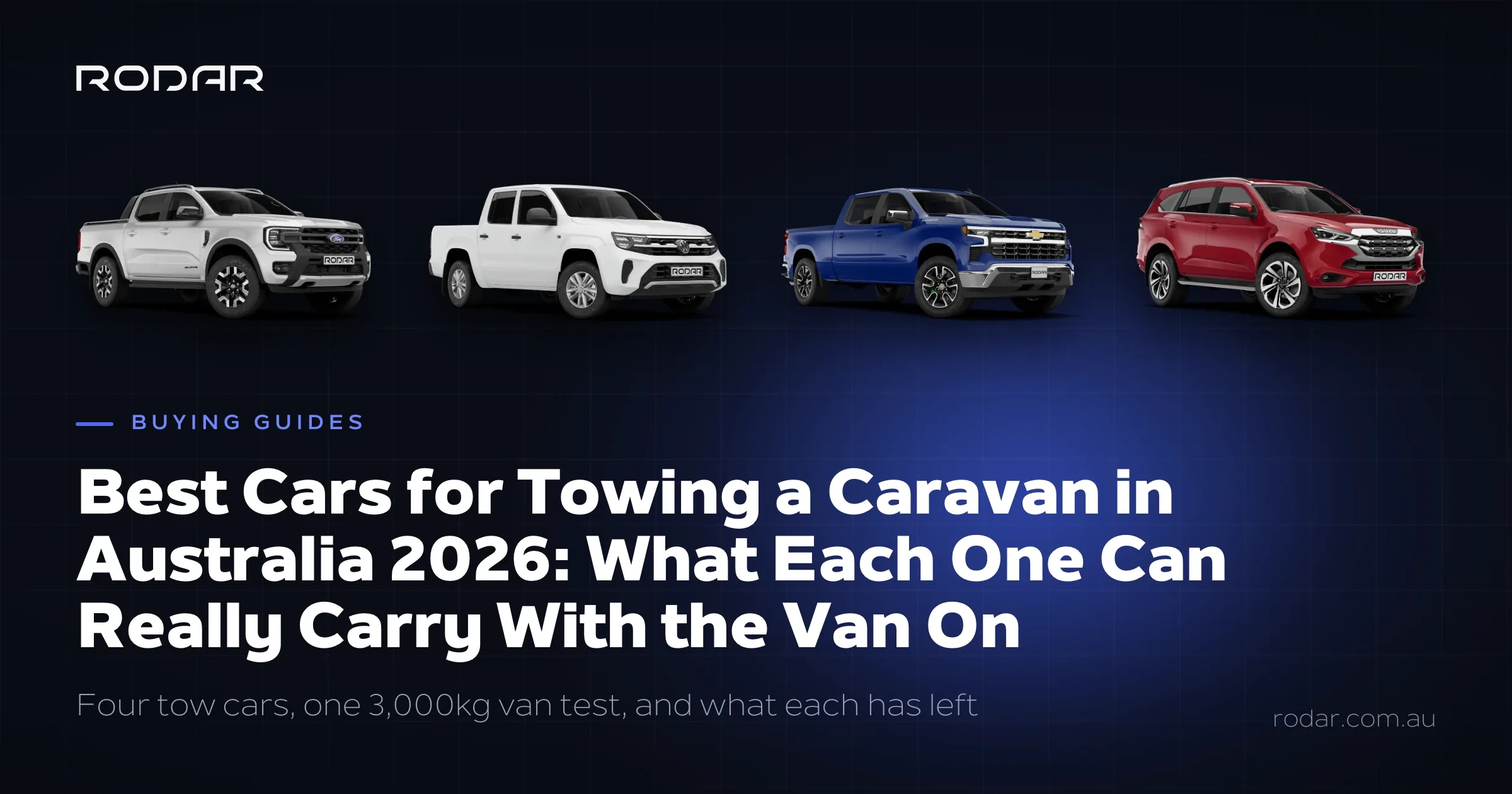
You have found the van. Now the car has to carry it, along with you, whoever is coming, and everything that does not fit inside the van. If you have read "3,500kg braked" on a dozen brochures and started to suspect it does not mean what it says, you are right to ask. The headline figure is the most visible number on the page and the least useful one on its own.
The good news is that the answer comes down to three numbers and two simple sums, and once you can do them you can check any car in a few minutes. There are strong options at every van weight. Below, we work the sums for four cars on one fixed test, show which limit runs out first, and explain the choices that lock those numbers in when you order. When you know the grade you want, Rodar can take it to our network of over 1,000 trusted automotive dealers and manufacturers and bring the offers back to you.
The three numbers that decide what you can tow
Every car on this list has three limits set by its maker. These definitions follow the WA Department of Transport and Major Infrastructure (DTMI), which takes them from the Australian Design Rules.
- Braked towing capacity. The heaviest braked trailer the car and its towing equipment are rated to pull. It is measured against the van's loaded weight, its Aggregate Trailer Mass (ATM).
- Gross Vehicle Mass (GVM). The most the car itself may weigh, fully loaded. That includes people, gear, accessories and the weight the van pushes down on the towball.
- Gross Combination Mass (GCM). The most the car and van may weigh together, coupled up and loaded.
Two more terms matter. Kerb weight is the car with a full tank, all its fluids and all its standard equipment, with nobody in it. Ball weight is the share of the van's weight resting on the towball. WA DTMI says it should ideally be 8 to 10 per cent of the van's loaded weight.
The two checks
A car and van have to pass both of these at the same time:
- The GCM check. The car, unhitched and loaded, plus the loaded van, must come in under the GCM.
- The GVM check. The loaded car plus the ball weight must come in under the GVM.
The ball weight is counted once in each check, never twice. The van's ATM already includes the weight on the ball, so the GCM check uses the unhitched car. The GVM check adds the ball weight because, once you hitch up, that weight is sitting on the car.
Start with the van's loaded weight, not its tare
Tare is what the van weighs empty. Water, gas, batteries, the annexe and the pantry all add to it. The number that counts in both checks is what the van weighs loaded the way you travel, up to its ATM. If you are not sure yet, use the ATM: it is the most the van may weigh, so a car that passes the checks at the ATM will still pass once the van is packed lighter.
One sum, worked in full
Take a Volkswagen Amarok Style V6 and a van that weighs 3,000kg loaded, with a 300kg ball weight. Volkswagen's MY26 brochure gives it a maximum kerb mass of 2,422kg, with a 3,350kg GVM and a 6,400kg GCM. Because that is the heaviest kerb figure Volkswagen lists, the results below are the least that will be left.
- GCM check. 2,422kg plus 3,000kg is 5,422kg. The GCM is 6,400kg, so at least 978kg is left.
- GVM check. 2,422kg plus 300kg is 2,722kg. The GVM is 3,350kg, so at least 628kg is left.
The smaller figure wins. With that van on, the Amarok has at least 628kg for you, your passengers, the fridge, the bikes, the firewood and anything bolted to the car after it left the factory. In this case GVM runs out first.
Why "3,500kg" is rarely 3,500kg
WA DTMI puts it plainly: GCM may be less than GVM plus towing capacity, and it may not be possible to tow a trailer at the braked rating while the car is at its GVM without going over the GCM. Ram Trucks Australia says the same thing about its own 1500: it cannot be run at maximum payload and maximum towing capacity at the same time. The braked figure is a ceiling for the van. What you can carry in the car while towing it is a separate question, and it is the one this article answers.
Which limit runs out first: the same test on four cars
Here is the same sum on each of the four ranked cars, at two van weights. At 3,000kg we use a 300kg ball weight. At 3,500kg we use 350kg. Both are 10 per cent of the van. "Left" is what remains for people, gear and accessories, and the last column names the limit that runs out first.
| Car and grade | Kerb | GVM | GCM | Left with a 3,000kg van | Left with a 3,500kg van |
|---|---|---|---|---|---|
| Ford Ranger Super Duty double cab chassis | 2,675kg | 4,500kg | 8,000kg | 1,525kg (GVM) | 1,475kg (GVM) |
| Volkswagen Amarok Style V6 | 2,422kg (maximum) | 3,350kg | 6,400kg | At least 628kg (GVM) | At least 478kg (GCM) |
| Chevrolet Silverado 1500 LTZ Premium | 2,552kg | 3,300kg | 7,160kg | 448kg (GVM) | 398kg (GVM) |
| Isuzu MU-X LS-T 3.0 | 2,185kg | 2,800kg | 5,900kg | 315kg (GVM) | 215kg (GCM) |
Look at the last column. With a 3,000kg van, every car here runs out of GVM first, because the ball weight comes out of the car's own payload. Move to 3,500kg and two of them switch: the Amarok and the MU-X now run out of GCM first. That is why "watch your GCM" is only half the advice. Which limit bites depends on your van.
All four are rated to tow at least 3,500kg braked. The kerb weights are the maker's published figure or, where the maker's figure was not available to us, the figure two independent sources agree on, for the exact grade named. For the Amarok we use Volkswagen's maximum kerb mass. A different grade, body or option pack weighs a different amount, so the result changes with it.
Kerb weight includes standard equipment only. If a towbar, bull bar or anything else is fitted at delivery as an accessory, its weight comes out of the "left" figure too.
The best cars for towing a caravan, ranked on what is left
These are ranked on what remains with a 3,000kg van on. That is our editorial call, and the trade-offs below matter as much as the number.
1. Ford Ranger Super Duty: the most room left, before the tray goes on
The Ford Ranger Super Duty is built for heavy work, with a 4,500kg braked towing rating, a 4,500kg GVM straight from the factory and an 8,000kg GCM. RACV and CarExpert both list the double cab chassis at 2,675kg kerb. That leaves 1,525kg with a 3,000kg van, and 1,475kg at 3,500kg.
&paintId=pspc0093&angle=1&zoomType=fullscreen&zoomLevel=30&width=800&fileType=webp&bodyType=pickup&bodySize=4)
Two things to weigh up. The cab chassis comes without a tray, and whatever tray and canopy you fit come straight out of that figure. And at 4,500kg, its GVM sits exactly on the line for a car licence in NSW, where a class C licence covers vehicles up to 4.5 tonnes GVM. Check your own state's rule before you order. If your van is heavier than 3,500kg, it keeps far more in hand than the Silverado below: with a 4,500kg van and a 450kg ball weight, GCM leaves 825kg. Its 130-litre tank also means fewer fuel stops with a van on.
2. Volkswagen Amarok Style V6: the tow gear already counted
The Volkswagen Amarok shares its underpinnings with the Ranger. In Style V6 form, on Volkswagen's maximum kerb mass, it has at least 628kg left with a 3,000kg van, and at least 478kg at 3,500kg, where GCM takes over.

Volkswagen's brochure lists a 3.5-tonne towbar, a trailer brake controller and a 12-pin trailer plug as standard from the Style up. Because they are standard, their weight is already in the kerb figure, and you are not buying them as extras later. The maximum towball weight is 350kg, which is 10 per cent of a 3,500kg van. Volkswagen also publishes the rear axle limit, 1,959kg on the Style V6, so you can check that too. The Style TDI600 has a retail price from $78,860, including estimated on-road costs.
3. Chevrolet Silverado 1500 LTZ Premium: big rating, honest margin
The Chevrolet Silverado 1500 LTZ Premium is rated at 4,500kg braked, and RACV and CarExpert agree on its figures: 2,552kg kerb, 3,300kg GVM and 7,160kg GCM. With a 3,000kg van it has 448kg left. At 3,500kg it has 398kg.

Here is the catch with a 4,500kg rating. Hitch a 4,500kg van and the GCM check leaves 108kg for everything and everyone in the car. The rating is real, but it suits a lighter van much better than a maximum one. RACV also notes that city driving and parking can be a chore, so think about the garage and the shopping centre car park for the rest of the year. The 1500 LTZ Premium has a retail price from $141,440, including estimated on-road costs.
4. Isuzu MU-X LS-T: seven seats, best with a lighter van
The Isuzu MU-X LS-T 3.0 has a 3,500kg braked rating, a 2,800kg GVM and a 5,900kg GCM, from Isuzu's own spec sheet. With a 3,000kg van it has 315kg left. At 3,500kg it has 215kg, because GCM takes over.
&paintId=pspc0093&angle=1&zoomType=fullscreen&zoomLevel=30&width=800&fileType=webp&bodyType=suv&bodySize=4)
That is a tight figure for seven seats and a full car. With a lighter van it is a very different car: at 2,500kg loaded, with a 250kg ball weight, it has 365kg left. Isuzu rates the towball at 350kg when fitted with a genuine Isuzu tow kit, and that kit is an accessory, so its weight comes off the figure. Grade matters here too. The LS-M 3.0 4x4 has 660kg of payload and the X-Terrain has 605kg. The LS-T has a retail price from $76,450, including estimated on-road costs. For more seven-seat options, see our guide to the best 7 seater SUVs.
Also worth a look, with the sum done on your exact grade
These are strong tow cars. For the grades below, the published weights either differ between sources or are incomplete. Ask for the kerb weight and payload of the exact grade and body you are quoted, in writing, then do the two checks above.
Nissan Patrol: the last V8 Patrol
The Nissan Patrol Ti is rated at 3,500kg braked, with a 3,500kg GVM, a 7,000kg GCM and a 140-litre tank on Nissan's own specifications. Nissan's specs page and its towing page give different payload figures for the Ti. Get the payload for the exact car in writing before you order, then do the two checks.
&paintId=pspc0132sspc0004&angle=1&zoomType=fullscreen&zoomLevel=30&width=800&fileType=webp&bodyType=suv&bodySize=4)
Grade matters here too. Nissan lists the Ti-L 61kg heavier than the Ti, with the same GVM. Nissan is promoting this as the last chance to secure a V8 Patrol. As at 10 September 2026, RACV reported final examples were still available to order, while the new Y63 Patrol, rated at 3,700kg braked, is due for first deliveries in early 2027. If you want the V8, finding one is about stock. The Ti has a retail price from $102,340, including estimated on-road costs.
The rest of the shortlist
- Ford Ranger V6. The Wildtrak V6 is rated at 3,500kg braked with a 3,350kg GVM and a 6,400kg GCM, the same as the Amarok Style V6.
- Ford Everest V6. Seven seats and a 3,500kg braked rating, with a 3,150kg GVM on the Sport V6. Our guide for families with twins covers it as a family car that also tows.
- Toyota LandCruiser 300. 3,500kg braked and a 3,280kg GVM on the VX. A long-distance favourite, but payload is the figure to check.
- Toyota LandCruiser Prado. 3,500kg braked. RACV says the payload left when towing at 3.5 tonnes can be quite restrictive, so check it against your van.
- Toyota LandCruiser 70 Series. Built for rough roads. The dual cab is a cab chassis, so the tray comes out of payload.
- Ram 1500, Toyota Tundra and Ford F-150. Full-size pick-ups rated at 4,500kg braked. As the Silverado shows, a 4,500kg rating can leave little in the car with a 4,500kg van, so run both checks on the grade you want.
The numbers are decided when you order
The van's weight is up to you and how you pack it. The car's limits are fixed the day it is built. Most of what decides your margin happens before delivery.
The grade you pick
Higher grades are usually heavier, so payload often falls as the price rises. On Volkswagen's figures, the Amarok Aventura V6 has a 3,190kg GVM and a 6,300kg GCM, against 3,350kg and 6,400kg on the Style V6, and its rear axle limit is 1,785kg against 1,959kg. The Aventura costs more and carries less. On Isuzu's sheet, the MU-X X-Terrain has 605kg of payload against 660kg on the LS-M 3.0 4x4. Choose the grade on its weights as well as its features.
What gets fitted before delivery
A bull bar, towbar, canopy, drawers, second battery, long-range tank and roof rack all come out of payload before the first trip. Ask for the weight of each accessory before you agree to it, and work out the sum with it included.
The rear axle
The rear axle has its own limit, and you can reach it before the GVM. Nissan's towing advice says axle capacities, in particular the rear, must be considered when a trailer is attached. The Patrol Ti's rear axle is rated at 2,030kg. If it is not in the brochure, ask for it.
A GVM upgrade: before or after registration
A GVM upgrade lets the car carry more. On a brand new car it can be done before registration, but only by a Second Stage Manufacturer approved by the federal government, using an approved kit. After registration it becomes a state process. In WA, that means an approved installer of a certified kit, or a modification certified by an automotive consultant and approved by DTMI.
Neither raises the braked towing capacity. Raising GVM does not automatically raise GCM either. WA DTMI warns that upgrading GVM without GCM reduces the trailer weight you can tow once the car is loaded to its new limit. Rules on GCM upgrades differ between states, so check yours. DTMI also advises checking with your insurer before any modification.
Timing against the van build
Caravans and new cars both run on lead times. Aim for the car to arrive before the van does, so you can weigh the car, fit what you need and know your numbers before the first trip. If you are replacing the car that towed your old van, its value is part of the same plan.
Before the first trip: weigh it
The sums tell you which car to buy. A weighbridge tells you where you actually are. Load the car and van the way you travel, with water, gas and food on board, and weigh the car alone, the van alone and the two together. Compare each result against the compliance plate and the van's ATM. The van has its own limit too: WA DTMI notes that the van's payload, its ATM minus its tare, must not be exceeded, and that safety, insurance and warranty may be affected if it is.
How Rodar helps you buy the right tow car
Every towing number belongs to a grade, not a badge. That is where we can help most. Pick the grade on its weights, then tell us the exact model, grade and colour. We put it to our network of over 1,000 trusted automotive dealers and manufacturers, and their drive-away offers come back side by side, all for the same car.
If the car is hard to find, such as one of the last V8 Patrols or a Ranger Super Duty, we search the network for stock. If the car is in stock and your finance is already sorted, delivery can take 24 to 48 hours. Most of the time it is one week onwards, depending on the model and stock availability across our network. We can also value the car that towed your old van and build it into the same changeover, arrange a car loan, or a chattel mortgage if you are buying through a business, and deliver the car to your door.
You have a van to fit out and a trip to plan. If it helps, let us take the car off your list. Whenever you are ready, get your competitive offers, or read our FAQs first to see how it works. No pressure either way.
Rates and repayments are indicative only and subject to lender approval. Rodar Pty Ltd is an Authorised Credit Representative (555548) of Fintelligence Pty Ltd (ACL 511803).
Skip the dealership haggle
Once you've picked a model, Rodar does the sourcing, comparison and negotiation for you — so you get the right car at the right price.
Build your car now